HSE & Sustainability

This paper presents an approach to the identification, selection, and implementation of initiatives for sustainable water management, withdrawal reduction, and water valorization.

This paper presents an experiment investigating dissolution of basaltic primary minerals and conditions favorable for secondary phase formation under deep subsurface storage conditions.

This study aims to investigate the efficacy of chemical additives strontium chloride and barium hydroxide in accelerating CO₂ trapping mechanisms, their effect on dissolution of carbonate-bearing minerals, and resulting poroelastic changes in the host rock.
-
 A critical support role within the upstream sector is played by the thousands who work in HSE and sustainability. The HSE performance of the industry has improved dramatically over the decades because of technological advances and a greater understanding of systems, processes, and human performance.
 -
This paper highlights the results of a test campaign for a tool designed to predict the short-term trends of energy-efficiency indices and optimal management of a production plant.
-
This paper presents the recent expansion of UNFC guidance to cover social and environmental effects and the further transformation of the system to make it a valuable tool in resource management for governments and businesses.
-
Researchers mapped 251 faults in the North Texas home of the Barnett Shale, the birthplace of the shale revolution, finding that wastewater injection there “significantly increases the likelihood for faults to slip.”
-
A joint-venture agreement gives Solaris control of Concho’s produced-water infrastructure in New Mexico, and Lagoon Water Solutions closed on a deal with Continental in Oklahoma.
-
Using direct air capture in the near-term is critical if the technology is going to be affordable at a truly large scale in the coming decades. Enhanced oil recovery is the most-economic way to do that.
-
A critical support role within the upstream sector is played by the thousands who work in HSE and sustainability. The HSE performance of the industry has improved dramatically over the decades because of technological advances and a greater understanding of systems, processes, and human performance.
-
“The Ohio Health Registry is really an attempt to collect the contacts of people who live close enough to any aspect of shale development that they might be affected,” said Deborah Cowden, a family physician who started the effort.
-
More than 60 producers participate in the program designed to reduce wellsite emissions.
-
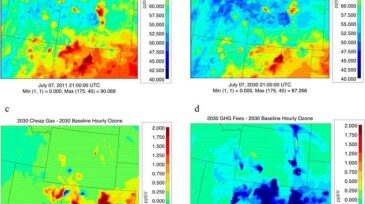
Research by Drexel University and the University of Colorado at Boulder suggests that imposing fees on energy producers that emit greenhouse gas could improve the health and financial well-being of the Rocky Mountain region.