HSE & Sustainability

This paper presents an approach to the identification, selection, and implementation of initiatives for sustainable water management, withdrawal reduction, and water valorization.

This paper presents an experiment investigating dissolution of basaltic primary minerals and conditions favorable for secondary phase formation under deep subsurface storage conditions.

This study aims to investigate the efficacy of chemical additives strontium chloride and barium hydroxide in accelerating CO₂ trapping mechanisms, their effect on dissolution of carbonate-bearing minerals, and resulting poroelastic changes in the host rock.
-
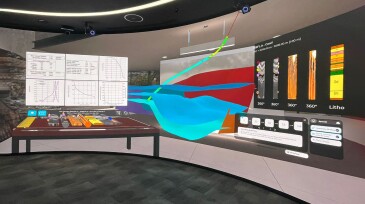
 Virtual reality and related visualization technologies are helping reshape how the industry views 3D data, makes decisions, and trains personnel.
 -
The objective of this paper is to outline the importance of new standards for studying hydraulic sealability of barrier materials, with an emphasis on interface analysis.
-
Australia’s Ichthys LNG facility will provide feedstock, along with production from legacy Japanese gas fields that will also serve as repositories for CO2 storage.
-
Texas regulators are taking public comment about how they should implement an EPA rule to reduce methane leaks from the oil and gas industry.
-
The institute is tasked with accelerating the deployment and scaling of cost-effective climate technology.
-
Ineos, the day-to-day operator of Greensand Future, with its partners Harbour Energy and Nordsøfonden, has made a final investment decision into the first commercial phase, with storage operations set to begin by early 2026.
-
This paper serves as a comprehensive overview of greenhouse-gas emission source data visibility in oil and gas production operations.
-
The acquisition will add water infrastructure in both the Midland Basin of west Texas and the Williston in North Dakota.
-
The drilling contractor is spending big to deploy natural-gas-powered microgrids and battery storage.
-
Permits for the East Side Cluster carbon storage project have been awarded, and participants have begun announcing final investment decisions.