Onshore/Offshore Facilities

With confidence in subsea boosting performance growing, BP is incorporating pumping systems into both greenfield developments and brownfield expansions.

This paper introduces channel stacking, a novel and efficient methodology designed to significantly improve optical gas imaging-based leak detection.

As the pace of new discoveries slows and high-quality prospects become harder to find, oil companies may need to rely more heavily on mature fields to maintain production and support future supply.
-
 The court said it was mindful of the disruption the shutdown will cause but said the seriousness of deficiencies from the US Army Corps of Engineers outweighs the negative effects of shutting down the pipeline.
 -
CB&I Storage Solutions joins a list of contractors working on the Trans Mountain Expansion Project.
-
A report from the Norwegian Petroleum Directorate details how production powered from shore would cut down on carbon dioxide emissions. All of the planned projects from the onshore power grid are expected by the mid-2020s.
-
The deal follows BP’s divestment of its global petrochemicals business in late June.
-
The Hydrogen Offshore Production project identifies an alternative to decommissioning by providing reuse options for offshore infrastructure. It aims to prove the feasibility of decentralized hydrogen generation, storage, and distribution to provide a bulk hydrogen solution.
-
The inspection projects to assess water ingress will be done via remotely operated vehicle.
-
With their gee-whiz—albeit artificial—intelligence, robots may be the industry’s answer to jobs deemed dangerous, dirty, distant, or dull.
-
The complete paper describes an advanced Rankine cycle process-based system that converts waste heat into usable electrical power to improve the efficiency of gas-compression stations on gas-production platforms and pipelines.
-
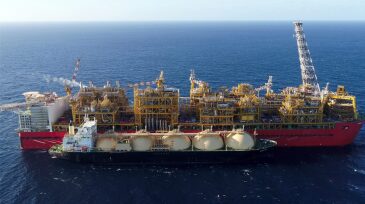
Two of the biggest assets to suffer from the new valuation are in Australia. Shell’s QGC venture and its floating liquified natural gas facility, Prelude, have been reduced in value by up to $9 billion.
-
The drop in US LNG exports comes amid a combination of weak demand, ample supply, additional capacity coming on line, and flexibility to cancel US cargoes.