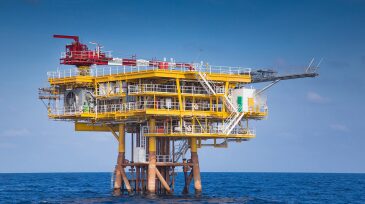
Onshore/Offshore Facilities

Shell has reached FID on LNG Canada Phase 2, a major expansion that will double the Kitimat facility’s LNG export capacity to 28 mtpa and strengthen long-term supply to growing Asian markets.

The 2026 Upstream Scale Guidelines establish a common workflow for field measurements, scale modeling, and risk assessment to support more consistent operational decisions.

The long-term outlook analysis says a potential shift toward new construction could push 2026 production 3% above 2025 levels.
-
 Subsea processing is a significant technology that presents and will continue to bring many challenges and opportunities to the industry.
 -
This paper summary focuses upon reporting new research-and-development (R&D) initiatives related to subsea processing and boosting offshore Brazil.
-
This paper focuses on the applicability of subsea-processing technology (SPT) using multiphase pumps (MPPs) to develop marginal fields commercially.
-
This paper summarizes the results of a qualification program that included a multiphase, subsea-separation system for shallow-water applications.
-
In June, the United States Federal Aviation Administration (FAA) issued the first approval for the overland use of unmanned aerial vehicles (UAVs) in Alaska.
-
Because of extremely high internal and external pressures, unconventional separator designs must be used in ultradeepwater applications. A major operator has qualified a number of subsea technologies covering a wide range of operating conditions and fluid properties that encompass its subsea portfol
-
Severe slugging is characterized by large pressure fluctuations at the base of the riser and is accompanied by fluctuations in fluid delivery from the top of the riser. This instability has negative effects on downstream equipment.
-
The value of new technology, and its ROI, is examined. Understanding the value proposition is not a trivial matter. When investing in facilities technologies, we have traditionally looked to invest in those that will reduce Capex or Opex. But what about niche technologies?
-
This paper analyzes the various selection methods of integrated template structures (ITSs) for use in the Arctic environment. Operation and installation of subsea modules in the Barents Sea are also analyzed in this paper.
-
As production from mature basins onshore and in shallow water declines, the development of deepwater reserves has become vital. Consequently, production and Capex are expected to rise.