Onshore/Offshore Facilities

The 2026 Upstream Scale Guidelines establish a common workflow for field measurements, scale modeling, and risk assessment to support more consistent operational decisions.

Shell has reached FID on LNG Canada Phase 2, a major expansion that will double the Kitimat facility’s LNG export capacity to 28 mtpa and strengthen long-term supply to growing Asian markets.

The long-term outlook analysis says a potential shift toward new construction could push 2026 production 3% above 2025 levels.
-
 The SPE Separations Technology Technical Section (STTS) hosted a special session titled “Unlocking Hidden Production Potential in Existing and Mature Fields” during the recent ATCE.
 -
While decommissioning is not new, the need is accelerating, along with cost and regulatory requirements. A panel at ATCE discussed the challenges in executing decommissioning projects.
-
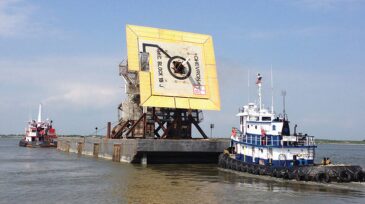
A strong reason for removing old platforms from the Gulf of Mexico, rather than trying to squeeze more years of marginal production out of them, is hurricanes.
-
When he started his firm focused on removing obsolete offshore structures, Brian Twomey chose the name: Reverse Engineering Services. The thinking was that taking out a structure is like building it, but in reverse.
-
Much of the new technology development occurring now is aimed at finding better ways to sever the thick, tough steel structures and wellheads so that they can be removed.
-
Riser slugging can restrict production and cause problems for downstream equipment. This paper discusses a simplified modeling approach to control of riser slugging.
-
After severe damage in a typhoon, the Huizhou oil field in the South China Sea was back on production in 5.5 months. This paper reviews how this feat was accomplished.
-
Over the next 5 years Douglas-Westwood (DW) expect USD 122 billion to be spent on global subsea vessel operations—an increase of 64% compared with the previous 5-year period.
-
Demand for a better way to remove carbon dioxide (CO2) from natural gas led to the creation of a new material at Rice University in Houston that does something unprecedented on the molecular scale, and might even change gas processing.
-
A project spearheaded by ExxonMobil, Shell, Chevron, and the Southwest Research Institute (SwRI) has been established to advance separation technology through improved testing methods and collaboration between users and suppliers.