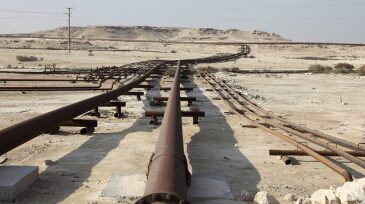
Pipelines/flowlines/risers

This work introduces a novel predictive methodology combining historical metocean data with real-time riser analysis for shallow water dynamically positioned rig operations.

The deals, with a potential value exceeding $3.7 billion, are aimed at strengthening Saudi Aramco’s supply chains and expanding its use of industrial artificial intelligence.

ExxonMobil and its Area 4 partners have awarded $1.1 billion in pre-investment contracts for long-lead upstream equipment supporting Mozambique's Rovuma LNG project. The awards, led by OneSubsea, mark a key step toward FID as development advances on ExxonMobil's largest global investment.
-
 Field trials were conducted by BP on the commercial version of wired pipe with a comprehensive suite of logging-while-drilling (LWD) tools, measurement-while-drilling (MWD) functionality, and rotary-steerable- capability on two Wyoming wells in 2007.
 -
Solid-expandable tubular (SET) is widely used to patch casing and has proved to be cost effective.
-
The general industry perception is that, when drillstrings or casing strings exceed conventional helical-buckling criteria, they cannot be operated safely in the hole because the risk of failure or lockup is too high.
-
Pipelines play a vital supporting role in the energy supply chain as one of the most efficient modes of hydrocarbon transportation. Unconventional resource development and LNG have set the stage for growth in onshore pipelines.
-
Paradoxical effects can exist when expanding the capacity of natural-gas-transportation networks. This paper derives conditions where it can be expected, how the effect can be masked, and provide analysis to support identification in larger-scale networks.
-
Riser margins were abandoned when fluid columns in risers became too long with increasing water depth accessed when floating drilling units with subsea blowout preventers (BOPs) moved to deep water.
-
A methodology is proposed for design of subsea flowlines and risers coupled with a subsea high-integrity pressure protection system (HIPPS) for fields with high shut-in tubing pressure (SITP).
-
This paper discusses the available methodologies for remediation of a pipeline affected by sand and presents examples where the discussed methodologies have been applied.
-
This paper presents a methodology to estimate the probability of failure of every individual corrosion defect and the residual likelihood of failure of an overall corroded pipeline segment after selected repairs, using structural probabilistic analysis.
-
This paper presents the results of tests conducted to design a fast-breaking gelled fluid for a debris-removal operation in a long, large-diameter subsea pipeline in the Asia Pacific region. where traditional pigging was not an option.