Production

This paper aims to establish a set of best practices for generating particle-size-distribution data from core samples.

Unlike traditional AI approaches that rely primarily on historical data, physics-based AI integrates physical laws, engineering expertise, and operational constraints directly into the learning process. Three recent SPE papers illustrate how this paradigm is transforming the industry through intelligent condition monitoring, virtual sensing, and autonomous production …

This research focuses on combining physics-based expert rules with machine learning to improve the detection of failure-related events in electrical submersible pumps.
-
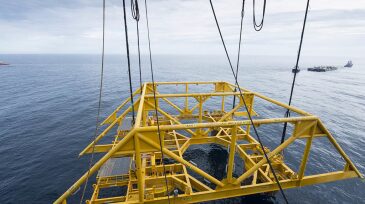
 A closer look at the design and construction of Statoil’s subsea gas compression systems in the Åsgard and Gullfaks fields, the first of their kind in the oil and gas industry.
 -
With Iran re-entering the global oil market, this article looks at the state of Iran's oil industry, the condition of its fields, its use of technology, and its present and future production potential.
-
Part of what makes DME an intriguing EOR technology is that it is soluble in both water and oil—with a preference for the latter. Shell’s plan is to add DME to the waterflooding stream to reach a concentration of about 16%, the upper limit of its dissolvability.
-
A study done to find the root cause of coiled tubing string failures in Montney indicated microbial-induced corrosion, leading the CT service provider to create a biocide treatment program.
-
Deepwater and ultradeepwater completions use numerous hydraulic control lines for control and actuation of downhole equipment.
-
Everhart Energy Technology, a startup company based in Beverly Hills, California, has developed a system it believes will help small to medium-sized operators cope with the reality that, while oil prices have fallen, their electric bills have not.
-
In maturing oil wells, oil production is often restricted as reservoir pressure depletes. Two case studies highlight the application of two-screw multiphase pump systems in to extend well life.
-
A refracturing campaign in the Permian yielded a production gain that allowed payback on the investment within 6–12 months.
-
Electrical submersible pump (ESP) systems are critical to achieving the maximum production rates and reservoir pressure drawdown that improve ultimate recovery. But variable volumes of gas in unconventional wells can pose challenges for performance of the ESP.
-
The Samarang oil field, offshore Sabah, Malaysia, is undergoing a redevelopment project with integrated operations. Several work flows were designed and deployed in order to achieve an early milestone of providing real-time well-performance monitoring, surveillance, and optimization.