Production

This paper aims to establish a set of best practices for generating particle-size-distribution data from core samples.

Unlike traditional AI approaches that rely primarily on historical data, physics-based AI integrates physical laws, engineering expertise, and operational constraints directly into the learning process. Three recent SPE papers illustrate how this paradigm is transforming the industry through intelligent condition monitoring, virtual sensing, and autonomous production …

This research focuses on combining physics-based expert rules with machine learning to improve the detection of failure-related events in electrical submersible pumps.
-
 Successful rejuvenation of two declining fields was enabled through innovation in both engineering and procurement strategy.
 -
Intervention and workover operations can significantly affect the structural integrity and fatigue life of subsea-wellhead systems. Methodologies for wellhead-fatigue analysis have improved, but have yet to account for thermal effects along the well. This study analyzes those thermal effects.
-
The sharp downturn in the offshore oil business has sparked interest in using subsea pumps to add production. If those conversations turn into orders, it may convert this rarely used option into a commonly used tool for extending the life of offshore fields.
-
A number of companies are pushing for alternative approaches to offshore development that seek to access marginal reservoirs. Their differing and unique ideas call for a departure from the usual playbook, but share a common goal of slashing capital costs.
-
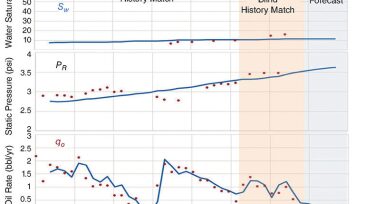
Young Technology Showcase—Top-Down Modeling: A Shift in Building Full-Field Models for Mature FieldsData-driven, or top-down, modeling uses machine learning and data mining to develop reservoir models based on measurements, rather than solutions of governing equations.
-
A new well intervention tool can solve annular isolation problems using a proprietary epoxy sealant placed at predefined locations, which can result in significant rig time savings. Field trial results are shared in this article.
-
Our problem is that we are dealing with multiphase, multicomponent fluids whose compositions change spatially and temporally inside imperfectly understood heterogeneous reservoirs whose characteristics also change spatially and temporally.
-
This work experimentally investigates the behavior of an intermittent multiphase liquid/gas flow that takes place upstream of an electrical submersible pump (ESP).
-
This paper describes a methodology for classification of artificial-lift-system (ALS) failures and addition of a commonly used root-cause failure classification.
-
When evaluating artificial-lift requirements, sometimes data present uncertainties at the initial planning stage. This paper presents the integrated and structured methodology that was used to deal with high-uncertainty conditions.