R&D/innovation

With funding opportunities improving, developers and researchers are focused on shortening project learning cycles and reducing uncertainty to attract more capital and speed deployment.
By integrating reservoir simulation, probabilistic seismic hazard and risk assessment, and machine learning, this study provides a practical framework for translating complex geoscientific research into evidence-based policy and field operations, achieving measurable reductions in seismic risk indicators in the Groningen gas field.

The US Department of Energy has awarded more than $99 million to 21 projects that will advance geothermal development through field-scale testing of next-generation technologies and exploration drilling programs across the US.
-
 Ongoing seismicity concerns and orphan well risks are pushing operators and regulators to explore alternatives for managing produced water.
 -
The $26-million project will serve as a collaborative hub for research, engineering, and testing.
-
The NLR has released its 2025 US Geothermal Market Report, documenting 4 years of industry growth and providing policymakers and stakeholders with an updated overview of the US geothermal market.
-
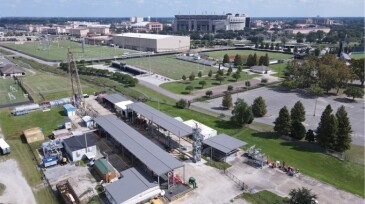
For more than a century, LSU has shaped petroleum engineering education, but few assets showcase its impact like the PERTT Lab. With six deep test wells and rare reservoir-depth gas-injection capabilities, the facility is helping drive breakthroughs in well control, carbon-dioxide injection, and next-generation energy technologies.
-
This article is the sixth and final Q&A in a series from the SPE Research and Development Technical Section focusing on emerging energy technologies. In this final edition, Matthew T. Balhoff, SPE, of The University of Texas at Austin shares his views on the future of upstream education.
-
As cutting-edge technologies unlock geothermal potential, Japan is channeling investments into powerhouse projects across the US, Indonesia, and New Zealand and priming its own reserves for a clean energy boom at home.
-
KTH researchers unveil a nickel/iron catalyst that speeds up water splitting, boosting efficient, sustainable hydrogen production.
-
SponsoredAs HPHT wells push equipment to the edge of material limits, operators are turning to advanced thermoplastics and sealed electrical assemblies to maintain system integrity. From ESP insulation to BOP control systems, the right component design can prevent failures, lower intervention costs, and extend equipment life in the harshest offshore environments.
-
SPE member Silviu Livescu has been chosen to receive the award in recognition of his groundbreaking contributions to next-generation, low-enthalpy geothermal energy systems, which are enabling widespread, cost-effective building heating and cooling solutions.
-
Technology developers expect the tight-oil industry to give lightweight proppants another look after the Permian Basin’s biggest operator becomes an adopter.