Reservoir characterization

Known as Arena, the collaboration aims to improve decision-making across increasingly complex reservoirs and growing volumes of subsurface data.

Three papers are highlighted as the primary contributions because of their broad industry relevance. They focus on improving formation particle-size characterization, expanding the application of openhole gravel packs in depleted and compartmentalized reservoirs, and advancing the understanding of capillary pressure in sand production.

By integrating experimental and mathematical modeling approaches, this work aims to advance the understanding of sand-detachment dynamics and formation instability under varying saturation conditions.
-
 The ability to predict the effect of faults on locating remaining hydrocarbon is critical to optimal well-placement, reservoir-management, and field development decisions.
 -
Newly developed ambient seismic imaging methods provide valuable information throughout the life cycle of an unconventional field.
-
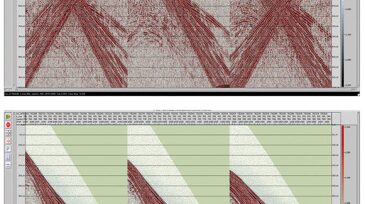
The word “broadband” is used to sell a lot of what is new in offshore seismic. It can mean different things depending on who is speaking.
-
Companies are using an increasing number of sound shots to gather more data in a shorter time frame.
-
Developing the Mad Dog discovery appeared to be high-risk because of the difficulty in mapping the subsurface because of the thick layer of salt underlying the region.
-
The pursuit of sweet spots in unconventional oil and gas plays is driving the creation of an emerging set of data-driven systems to measure, map, and predict how wells will perform in unconventional reservoirs.
-
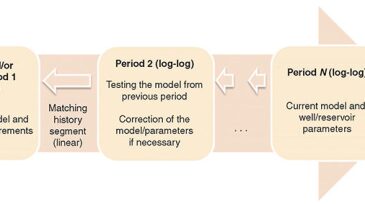
Permanent downhole gauges (PDGs) provide vast amounts of pressure-transient and rate data which may be interpreted with improved pressure-transient-analysis (PTA) approaches to gain more knowledge about reservoir dynamics.
-
This paper provides a more straightforward method for estimating stress-dependent permeability and capillary pressure in rock fractures.
-
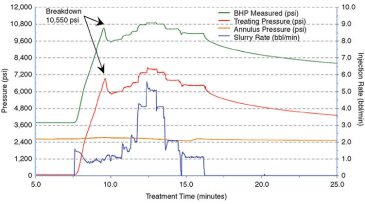
In hydraulic fracturing, the use of diagnostic-fracture-injection tests (DFITs) can provide valuable information.
-
This paper focuses on the aspects of proppant selection and adequate fracture-conductivity placement, with the goal of improving well productivity and cumulative recovery.