Reservoir characterization

Known as Arena, the collaboration aims to improve decision-making across increasingly complex reservoirs and growing volumes of subsurface data.

Three papers are highlighted as the primary contributions because of their broad industry relevance. They focus on improving formation particle-size characterization, expanding the application of openhole gravel packs in depleted and compartmentalized reservoirs, and advancing the understanding of capillary pressure in sand production.

By integrating experimental and mathematical modeling approaches, this work aims to advance the understanding of sand-detachment dynamics and formation instability under varying saturation conditions.
-
 Recent technical papers have further shown the steady increase in the application of advanced seismic techniques and machine learning to mature to production “stranded” and “advantaged” hydrocarbon-bearing accumulations ; improve carbon capture, storage, and leak detection; and analyze naturally and artificially fractured reservoirs.
-
Uncertainty comes in all scales and dimensions. This challenges us to learn at all scales possible, from the fume hoods in the laboratory to magnificently exposed outcrops and through deep narrow boreholes that drill through subsurface reservoirs. The combined efforts often convert learnings to actionable intelligence.
-
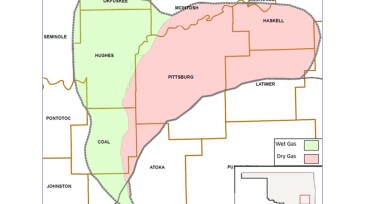
This paper describes an effort to use multiple technologies to better understand an Arkoma Basin reservoir and the interdisciplinary relationship between the reservoir’s subsurface hazards and a stimulation treatment.
-
The authors of this paper propose an artificial-intelligence-assisted work flow that uses machine-learning techniques to identify sweet spots in carbonate reservoirs.
-
The authors of this paper describe a seismic reprocessing campaign for an Egyptian oil field that had yielded poor seismic data.
-
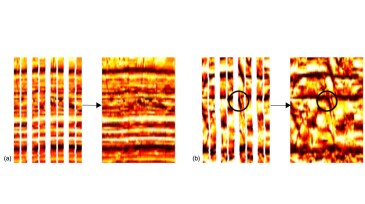
This paper describes a method with multitiered analysis to leverage machine-learning techniques to process passive seismic monitoring data, pumping and injection pressure, and rate for fracture and fault analysis.
-
The main objective of this paper is to investigate the relationship between strain change and pressure change under various fractured reservoir conditions to better estimate conductive fractures and pressure profiles.
-
Development and study of a new downhole bubblepoint pressure measurement technique, suitable for black oils and volatile oils, to augment downhole fluid analysis using optical spectroscopy.
-
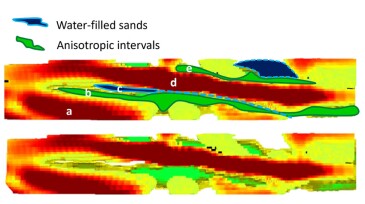
The authors of this paper describe an approach in which all available technologies are combined to improve understanding of reservoir depositional environments.
-
The authors of this paper describe a project aimed at automating the task of cuttings descriptions with machine-learning and artificial-intelligence techniques, in terms of both lithology identification and quantitative estimation of lithology abundances.