Reservoir characterization

Known as Arena, the collaboration aims to improve decision-making across increasingly complex reservoirs and growing volumes of subsurface data.

Three papers are highlighted as the primary contributions because of their broad industry relevance. They focus on improving formation particle-size characterization, expanding the application of openhole gravel packs in depleted and compartmentalized reservoirs, and advancing the understanding of capillary pressure in sand production.

By integrating experimental and mathematical modeling approaches, this work aims to advance the understanding of sand-detachment dynamics and formation instability under varying saturation conditions.
-
 This paper presents laboratory-testing methods and evaluation criteria designed to improve understanding of both the origin and extent of formation damage associated with CO2 injection.
 -
This work presents an evaluation for carbon capture, utilization, and storage projects in the UAE for two wells in a saline water aquifer with respect to caprock integrity and water sampling.
-
This work introduces an analytical model for nonisothermal CO2 injection that accounts for both Joule-Thomson cooling and interformation heat exchange.
-
This study demonstrates how routinely acquired downhole temperature data allows for direct estimation of fluid saturations and delivers more accurate reservoir volume assessments, particularly in aquifer-supported systems.
-
SponsoredEffective data analysis depends on seeing connections that matter. Explore how Spotfire enables a more intuitive approach to understanding petroleum data.
-
This study applies Monte Carlo simulation and an XGBoost regression model to assess the influence of various formations, geologic provinces, tectonic-plate types, and boundary conditions on hydrogen concentrations.
-
This paper presents a novel approach to predict reservoir porosity by conditioning seismic data, calibrating seismic impedance inversion, and tailoring rock-physics analysis.
-
This paper aims to assess the effectiveness of using advanced integrated production-data-analysis techniques for condensate-rich tight gas fields.
-
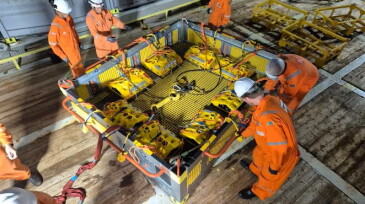
The technology has passed its first phase of qualification, with 84 nodes placed on the seafloor at a depth of 2,000 m to acquire 4D seismic data in the pre-salt Santos Basin.
-
Xu outlines the thinking and theories that led his team to six world-class oil discoveries that total more than 100 million tons of proven geological reserves since 2021.