Reservoir simulation

This article from the SPE Integrated Reservoir Management Technical Section (IRMTS) examines the closed-loop IRM approach, from insight to execution to learning, and the limits of technology-driven solutions.

This work applies fuzzy logic, a well-established artificial-intelligence technique, to quantitatively assess connectivity between injectors and producers in a giant presalt field in the Santos Basin of Brazil.

This paper presents a reduced physics-based model that accelerates the ability to screen infill-location optimization, using the fast marching method to maximize production for a reservoir with multiple realizations.
-
 The newest recipient of the title SPE Legend of Hydraulic Fracturing talks about his career, the evolution of fracture stimulation, the development of increasingly useful simulators, and the future of the oil and gas industry. The honor was given at the 2026 SPE Hydraulic Fracturing Technology Conference and Exhibition.
 -
The authors propose a deep-learning-based approach enabling near-real-time CO2-plume visualization and rapid data assimilation incorporating multiple geological realizations for predicting future CO2 plume evolution and area-of-review determination.
-
In this study, forward simulation is executed by a commercial reservoir simulator while external code is developed for backward calculations.
-
In this study, the authors propose the use of a deep-learning reduced-order surrogate model that can lower computational costs significantly while still maintaining high accuracy for data assimilation or history-matching problems.
-
This paper reviews the simultaneous supercritical CO2/brine aquifer injection and water-alternating-gas methods for geologic carbon sequestration and proposes a novel integration with saltwater-disposal wells.
-
The objective of this study is to numerically investigate system behavior when storing H2/natural gas (CH4) mixtures in aquifer-related underground gas storage, and the effect of gas composition and salinity on energy-recovery efficiency.
-
This paper addresses the difficulty in adjusting late-stage production in waterflooded reservoirs and proposes an integrated well-network-design mode for carbon-dioxide enhanced oil recovery and storage.
-
This work presents the development of fast predictive models and optimization methodologies to evaluate the potential of carbon-dioxide EOR and storage operations quickly in mature oil fields.
-
The authors of this paper apply a deep-learning model for multivariate forecasting of oil production and carbon-dioxide-sequestration efficiency across a range of water-alternating-gas scenarios using field data from six legacy carbon-dioxide enhanced-oil-recovery projects.
-
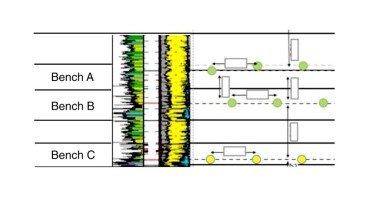
The aim of this study is to incorporate detailed geological, petrophysical, and hydraulic fracturing models to better predict and mitigate the effects of interbench interactions.