Reservoir

Industry experts at URTeC assessed more than a decade of unconventional growth while discussing where productivity gains will come from next.
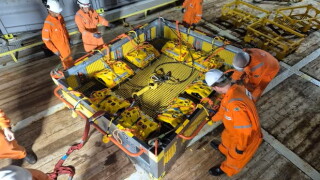
The technology has passed its first phase of qualification, with 84 nodes placed on the seafloor at a depth of 2,000 m to acquire 4D seismic data in the pre-salt Santos Basin.

Chevron and Halliburton describe how they built and deployed the fully autonomous closed-loop fracturing system that enables subsurface-driven optimization.
-
 The story of unconventional oil and gas technology development has been focused on fractures. The formula has been more stages, more sand, and more water, targeting the most productive spots.
 -
With declining trends in production and dwindling reserves for a 35-year-old offshore field, the Samarang Redevelopment Project was initiated with a vision toward implementing integrated operations as an asset-management decision-support tool.
-
This paper presents approaches for proper risking of uncertain recoverable volumes for an unconventional resource, taking into account the chance of false positives from appraisal-well information.
-
The optimization algorithm used in this work is a hybrid genetic algorithm (HGA), which is the combination of GAs with artificial neural networks (ANNs) and evolution strategies (ESs).
-
Earthquake in Cushing, OK -- home to the largest oil storage facility in the world -- leads to further regulatory action on disposal wells in the area.
-
Compared to oil in the ground, the sun looks like a limitless energy source. Making comparisons of the two by calculating the equivalent of barrels of reserves for a solar project seems like an odd notion, but experts say it can and should be done.
-
Saudi Aramco has begun moving toward the production phase of its ambitious plan to develop its enormous hoard of unconventional gas resources.
-
Saudi Aramco saw a jump in production for a type of EOR that often takes years to see full benefits.
-
Understanding petrophysical properties well enough to make drilling decisions, particularly for tight gas can be a challenge. A new computer system aims to help analyze the extensive data involved.
-
This paper offers an alternative explanation for the early boundary-dominated flow related to dissolution of salt-sealed natural fractures in the shale.