Reservoir

Industry experts at URTeC assessed more than a decade of unconventional growth while discussing where productivity gains will come from next.
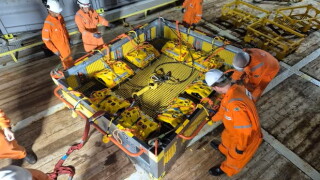
The technology has passed its first phase of qualification, with 84 nodes placed on the seafloor at a depth of 2,000 m to acquire 4D seismic data in the pre-salt Santos Basin.

Chevron and Halliburton describe how they built and deployed the fully autonomous closed-loop fracturing system that enables subsurface-driven optimization.
-
 On the basis of production data, diagnostic methods, and field observations, it is becoming increasingly clear that induced unpropped fractures created during the hydraulic-fracturing operation play a critical role in determining the success of fracture treatments.
 -
The current reservoir-performance-monitoring technologies are being improved continuously for better reservoir understanding, more-accurate short- and long-term production forecasting, and lower overall operational costs.
-
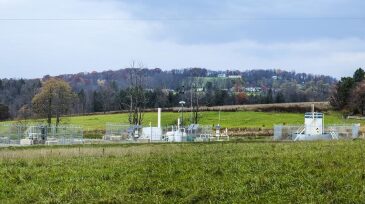
In this work, the authors perform automatic decline analysis on Marcellus Shale gas wells and predict ultimate recovery for each well.
-
In this work, the authors perform automatic decline analysis on Marcellus Shale gas wells and predict ultimate recovery for each well.
-
Partitioning interwell tracer tests (PITTs) have been used to estimate remaining oil saturations (ROSs) during waterflooding.
-
This paper reviews the design and implementation of a full-field interwell tracer program for a giant onshore oil field in Abu Dhabi.
-
For nearly a decade, Saudi Aramco has been studying how altering the chemical makeup of seawater injected into its reservoirs can increase production. The result is "smart water" that can boost the sweep effectiveness of a waterflood.
-
Distributed temperature sensing (DTS) is the most common fiber-optic measurement used for steam-assisted-gravity-drainage reservoir monitoring.
-
In this study, the authors demonstrate a reliable, cost-effective methodology that empowers shale operators with reservoir data on every well.
-
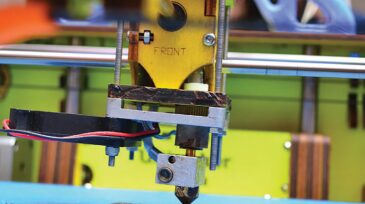
Researchers at Heriot-Watt University in Edinburgh, Scotland, are building replica core samples using 3D printers and installing sensors inside them as they go. Their goal is to directly monitor pore-scale flow behavior from the inside of these so-called “smart rocks.”