Reservoir

Industry experts at URTeC assessed more than a decade of unconventional growth while discussing where productivity gains will come from next.
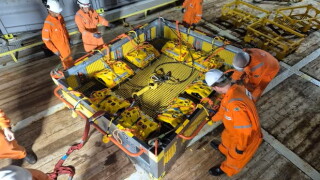
The technology has passed its first phase of qualification, with 84 nodes placed on the seafloor at a depth of 2,000 m to acquire 4D seismic data in the pre-salt Santos Basin.

Chevron and Halliburton describe how they built and deployed the fully autonomous closed-loop fracturing system that enables subsurface-driven optimization.
-
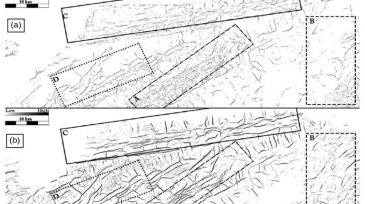
 The tedium of identifying small faults in often murky seismic images pushed Dustin Dewett, an associate geophysicist for BHP Billiton, to develop a better way to use the tools at hand.
 -
In this study, samples of flowback water and downhole shales are analyzed to investigate the mechanisms controlling the chemistry of flowback water.
-
Following years of deliberation, the European Union (EU) released a recommendation on unconventional hydrocarbons and a related communication in 2014. This paper traces the origins and development of these documents, which provide vital clues for the road ahead in European shale-gas regulation.
-
Research and development firm Battelle is working on a new induced-seismicity study that aims to help wastewater disposal well operators in Ohio stay on the good side of state regulators.
-
Coalbed methane development can require a large volume of wells, but the costs of logging can be prohibitive, so alternate formation-evaluation solutions are being evaluated. This paper compares state-of-the-art mining logging technology with conventional oil-and-gas approaches.
-
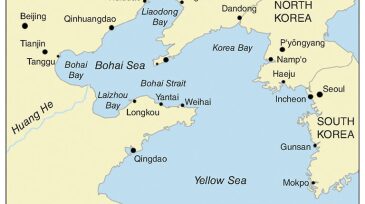
A new multilayer boundary‑detection service has been introduced to resolve the geological uncertainty associated with horizontal wells in Bohai Bay. Geosteering and real time reservoir characterization were used to reduce the uncertainty.
-
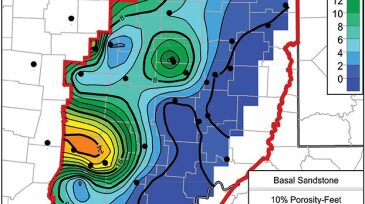
Saturation-height functions (SHFs) play a key role in reservoir description and in quantifying oil in place. The functions must compare well with other sources of water saturation (Sw), such as core measurements and well-log interpretations. This study reconciles different sources of Sw.
-
The list of the biggest gas plays in the US is being revised as the US Geological Survey creates new estimates based on additional drilling results and available rock samples. New at Number 2 is the Mancos Shale on the Western Slope of the Rockies with 66 Tcf in recoverable reserves.
-
To do more with less, standardization and automation will be key. Application of techniques honed in other industries need to be evaluated as part of the path toward standardized approaches.
-
Because the uncertainty analysis is complex and time consuming, in this paper, a stochastic representation of the computer model, called an emulator, was constructed to quantify the reduction in the parameter input space.