Reservoir

A report commissioned by Havtil, the Norwegian Ocean Industry Authority, calls for better dialogue regarding pore-pressure uncertainty and higher-end drilling techniques like managed pressure drilling as methods to reduce the risk of well-control events.

The events will be co-located 3–5 May 2027 at Reliant Park in Houston, Texas.

Bridging the gap between foundational guidance and real-world application, SPE’s Oil and Gas Reserves Committee is advancing PRMS education with a new, peer-reviewed training initiative. This article highlights the evolution of the PRMS knowledge base and introduces the PRMS Training Master Slides—a modular, instructor-led framework designed to improve consistency, cl…
-
 This paper outlines the key issues that must be addressed from a regulatory perspective in regard to the development of an onshore unconventional-gas industry in the Northern Territory.
 -
In unconventional plays, comparing the effect of different completion designs or well-management strategies on well performance remains a challenge because of the relatively brief production history and lack of long-term field analogs of these plays.
-
With multistage operations becoming the industry norm, operators need easily deployable diversion technologies that will protect previously stimulated perforations and enable addition of new ones. This paper reviews several aspects of the use of in-stage diversion.
-
Nearly a decade after an SPE meeting in Bruges set industry-inspiring benchmarks for reservoir modeling, the time has come to overcome a new set of challenges.
-
Conventional inflow-performance-relationship (IPR) models are used in coupled wellbore/reservoir transient simulations, even if bottomhole-pressure conditions are assumed to be constant on the derivation of such IPR models.
-
Because of their heterogeneity, carbonate reservoirs are more difficult to model than clastic reservoirs. The main difficulty comes from the number of different pore types, compared with the typical interparticle pore type in clastics.
-
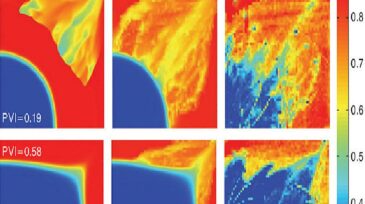
This paper addresses the challenges in modeling highly unstable waterflooding, using both a conventional Darcy-type simulator and an adaptive dynamic prenetwork model, by comparing the simulated results with experimental data including saturation maps.
-
You want to know how to immediately make a step change in your business and improve your own promotion prospects. You want to know the key technologies you should be implementing now. To develop your longer-term strategy, you want an awareness of future trends now. Consider your wish granted.
-
Global emissions of CO2 resulting from the use of fossil fuels amount to approximately 35 billion tons/yr. How much of this can we capture? How much can we store or sequester? And, perhaps the most important question: How much will it cost and who will pay?
-
An operator has designed a demonstration project for carbon dioxide (CO2) enhanced oil recovery (EOR) and has implemented it in one of its fields.