

Reservoir

The next wave of unconventional growth will likely come from basins in Argentina, the Middle East, Australia, and elsewhere, fueled by expertise gained from shale plays in North America.

Industry experts at URTeC assessed more than a decade of unconventional growth while discussing where productivity gains will come from next.
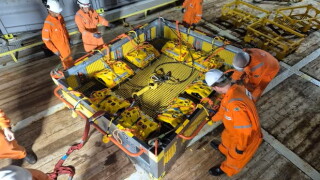
The technology has passed its first phase of qualification, with 84 nodes placed on the seafloor at a depth of 2,000 m to acquire 4D seismic data in the pre-salt Santos Basin.
-
 In this study, the authors propose the use of a deep-learning reduced-order surrogate model that can lower computational costs significantly while still maintaining high accuracy for data assimilation or history-matching problems.
 -
The newest recipient of the title SPE Legend of Hydraulic Fracturing talks about his career, the evolution of fracture stimulation, the development of increasingly useful simulators, and the future of the oil and gas industry. The honor was given at the 2026 SPE Hydraulic Fracturing Technology Conference and Exhibition.
-
This paper introduces a novel steam-sensitive flow-control device designed to restrict the production of steam and low-subcool liquids while allowing higher mobility of oil-phase fluids.
-
This paper describes the operator’s initiative to reduce greenhouse-gas emissions and recover additional hydrocarbon, monetizing it as sales gas, by integrating upstream and downstream gas facilities in a unified approach.
-
This paper demonstrates how the integration of multiphysics downhole imaging with machine-learning techniques provides a significant advance in perforation-erosion analysis.
-
This study integrates laboratory testing with reservoir simulation to evaluate the effectiveness of autonomous inflow-control valves in managing late-life steam-assisted gravity-drainage production challenges.
-
This paper presents a workflow that leverages a multiagent conversational system to integrate data, analytics, and domain expertise for improved completion strategies.
-
Examples demonstrate how an Integrated Operations Center as a Service (IOCaaS) model, powered by artificial intelligence, reduced costs by 5% and increased production by 6% in Canada.
-
This paper demonstrates the effectiveness of integrating dynamic gas separation with existing gas-avoidance methods within the same electrical submersible pump string to address these issues.
-
The operator developed a solution that has kept the well at stable production for over a year after treatment.


