Reservoir

This study explores the carbon-capture and mineralization potential of ultramafic rock powders when exposed to flue gases generated from combustion of crude oil and mesquite-derived charcoal.

This paper documents the testing, integration, and field deployment of a metal expandable packer used as an openhole toe isolation plug in a deepwater well under high-pressure, high-temperature conditions.

Three papers are highlighted as the primary contributions because of their broad industry relevance. They focus on improving formation particle-size characterization, expanding the application of openhole gravel packs in depleted and compartmentalized reservoirs, and advancing the understanding of capillary pressure in sand production.
-
 Senior Research Scientist and SPE Distinguished Lecturer Ian Walton uses a semianalytic shale gas production model to show that natural fractures, contrary to the intuitive beliefs of many, do not contribute significantly to production.
 -
Emerging technologies have helped bring about multilateral, maximum-contact, and smart-completion wells, allowing reservoirs to be developed and produced much more efficiently and economically. In this, formation evaluation plays a critical role.
-
The F field in the Middle East currently has more than 40 producing wells in the center of the structure. The uneven well distribution limits the understanding of 3D reservoir characterization, particularly in the flank areas.
-
This study focuses on recent experience in Saudi Arabia with crude-oil compositional analyses during pumpout with a wireline formation tester (WFT).
-
The resistivity index (RI) of Fontainebleau and Bentheimer sandstones was investigated at ambient and reservoir pressures down to low water saturations. The RI measurements show that both sandstones display Archie behavior at elevated pressure.
-
Petronas cancels plans for the development of the Pacific Northwest LNG project in British Columbia intended to take away natural gas from the Montney formation for shipping to Asian countries. Low LNG prices strike a blow to the feasibility of the project.
-
Researchers: Models Overstate Technology Impact, Understate Location Impact for Unconventional WellsTwo researchers at the MIT Energy Initiative have found that current modeling overestimates the impact of new technology on unconventional well productivity and underestimates that of increasingly targeting reservoir “sweet spots.”
-
As well-developed shale plays and tight formations mature and decline in production, nontraditional strategies for maximizing production and discovering new resources must be considered.
-
Nearly a decade after an SPE meeting in Bruges set industry-inspiring benchmarks for reservoir modeling, the time has come to overcome a new set of challenges.
-
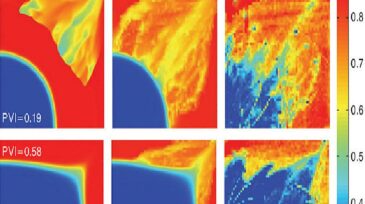
This paper addresses the challenges in modeling highly unstable waterflooding, using both a conventional Darcy-type simulator and an adaptive dynamic prenetwork model, by comparing the simulated results with experimental data including saturation maps.