Reservoir

Canada’s development of large-scale digital drilling core libraries and open geoscience data platforms follows approaches pioneered in Australia, particularly Western Australia, through decades of government investment in geoscience data collection and preservation.

Three papers are highlighted as the primary contributions because of their broad industry relevance. They focus on improving formation particle-size characterization, expanding the application of openhole gravel packs in depleted and compartmentalized reservoirs, and advancing the understanding of capillary pressure in sand production.

This paper aims to establish a set of best practices for generating particle-size-distribution data from core samples.
-
 Work conducted in the Surmont field of Alberta, Canada, provided an excellent starting point to optimize flow-control improvements to the SAGD process.
 -
Some remarkable breakthroughs in data quality have been shared in recent reviews, and the ongoing technical developments in data acquisition and processing remain truly exciting.
-
Through examples of subsalt fields of the Kaombo project, we show how new techniques have had a positive effect.
-
The Risha concession, in the desert of eastern Jordan (bordering Iraq, Syria, and Saudi Arabia) contains the partially developed Risha gas field.
-
Research into whether CO2 can be used to coax billions more barrels of oil from unconventional formations is beginning to show promise.
-
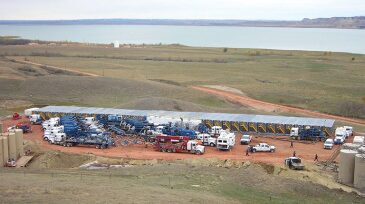
Tests showing increased recoveries in the Bakken formation using CO2 could have significant implications for the upstream oil and gas industry.
-
Tight gas reservoirs and shale gas reservoirs are economically viable hydrocarbon prospects that have proved to be successful in North America.
-
This is the most exciting time for enhanced oil recovery (EOR) in recent memory. At last, almost everyone is talking about increasing recovery factors, and improved oil recovery (IOR) and EOR are being considered natural components of reservoir management.
-
Foam simulation brings various numerical challenges. Some of these problems are largely cosmetic.
-
This paper discusses the process undertaken by the Clair Ridge project in getting RS enhanced oil recovery (EOR) adopted as a Day-1 secondary waterflood.