Reservoir

This paper documents the testing, integration, and field deployment of a metal expandable packer used as an openhole toe isolation plug in a deepwater well under high-pressure, high-temperature conditions.

Three papers are highlighted as the primary contributions because of their broad industry relevance. They focus on improving formation particle-size characterization, expanding the application of openhole gravel packs in depleted and compartmentalized reservoirs, and advancing the understanding of capillary pressure in sand production.

This paper aims to establish a set of best practices for generating particle-size-distribution data from core samples.
-
 This paper reviews the efforts to exploit CBM resources in Indonesia, the challenges these efforts have faced, and possible solutions that can make operations more efficient and profitable.
 -
Recently, a lot of discussion has revolved around the benefits of multilaterals in unconventional reservoirs, but is it truly the next breakthrough for the industry, or is it all hype?
-
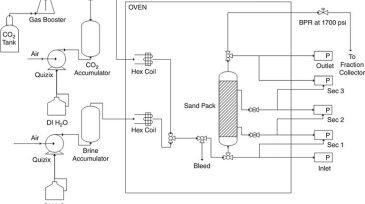
Aqueous foam has been demonstrated to have promise in conformance-control applications. This paper explores the foaming behavior of a CO2-soluble, cationic, amine-based surfactant.
-
A carbon-dioxide (CO2) -foam enhanced-oil-recovery (EOR) pilot research program has been initiated to advance the technology of CO2 foam for mobility control in a heterogeneous carbonate reservoir.
-
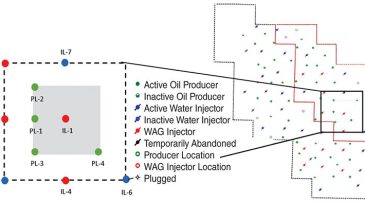
This paper presents an analysis of a CO2-foam-injection pilot in the Salt Creek Field, Natrona County, Wyoming.
-
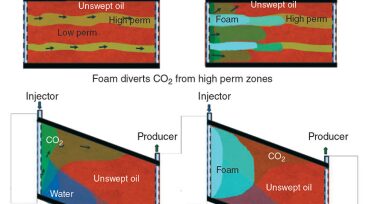
In my previous features, I discussed the challenges facing carbon dioxide (CO2), both technical and economic. By far the biggest use of CO2 is in enhanced oil recovery (EOR). In this feature, the focus is on overcoming the biggest challenges facing CO2 EOR—gravity override and mobility.
-
The Norwegian operator’s disclosure marks the first time all subsurface and production data from a field on the NCS will be available for public viewing.
-
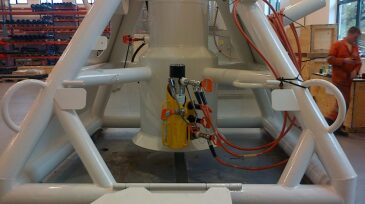
Acquiring data from an abandoned subsea well has been done before, but never quite like this.
-
The evolution of horizontal drilling and multistage completions has changed matrix stimulation from the “more acid, better result” belief to effective lateral distribution and deeper penetration with less acid.
-
CO2 injection is a successful EOR technology that has been deployed extensively in the Permian Basin. Further expansion of CO2 EOR has been limited by the availability of affordable CO2 rather than the existence of suitable target reservoirs. This situation may be about to change.