Reservoir

Three papers are highlighted as the primary contributions because of their broad industry relevance. They focus on improving formation particle-size characterization, expanding the application of openhole gravel packs in depleted and compartmentalized reservoirs, and advancing the understanding of capillary pressure in sand production.

This paper aims to establish a set of best practices for generating particle-size-distribution data from core samples.

This paper discusses the successful execution of two openhole gravel-pack completions in two Gulf of Mexico fields with depleted reservoirs.
-
 BP ends a year of speculation as to who will buy BHP Billiton’s much-coveted US unconventional business, transforming its Lower 48 portfolio in the process.
 -
Today’s advancements in unconventional technology are worth marveling over, but there is still plenty of room for growth.
-
The report card for unconventional oil and gas producers from a leading industry analyst is A+ for growth and F- for paying back investors.
-
SponsoredBy adopting enhanced oil recovery (EOR) techniques, the amount of oil that could be recovered could be increased by as much as 30% to 70%. Low Salinity Water Flooding (LSWF) is flexible and has a low cost, with a readily accessible feedstock – seawater.
-
This paper presents a saturation-modeling approach for fields and reservoirs with complex hydrocarbon-charging histories. The model resolves saturation-height functions for the primary-drainage, imbibition, and secondary-drainage equilibriums.
-
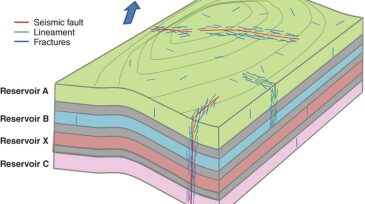
This paper proposes a novel work flow for structural-features modeling that allows the introduction of faults and other structural and nonstructural features to any simulation grid without modification.
-
Natural fractures can have a significant effect on fluid flow by creating permeability anisotropy in hydrocarbon reservoirs.
-
A radical digital revolution is happening all around us (or so we are told). Applying this to reservoir simulation, we apparently need to understand better when and, more importantly, when not to use such technology—to appreciate its bounds, its limitations, its range of validity, and so on.
-
This paper presents a literature review to determine the engineering challenges and opportunities presented by CBM production in China.
-
The Apollonia tight-gas chalk play is located in the Abu Gharadig Basin in the Western Desert of Egypt. This has long been ignored as a gas play in the overburden, while the Jurassic and Cretaceous oil fields deeper in the basin have been explored and developed.