Reservoir

Three papers are highlighted as the primary contributions because of their broad industry relevance. They focus on improving formation particle-size characterization, expanding the application of openhole gravel packs in depleted and compartmentalized reservoirs, and advancing the understanding of capillary pressure in sand production.

This paper aims to establish a set of best practices for generating particle-size-distribution data from core samples.

This paper discusses the successful execution of two openhole gravel-pack completions in two Gulf of Mexico fields with depleted reservoirs.
-
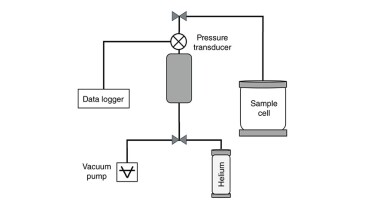
 This paper introduces new methods to perform reliable permeability and saturation-dependent relative permeability measurements in organic-rich mudrock core samples using a pressure-decay setup.
 -
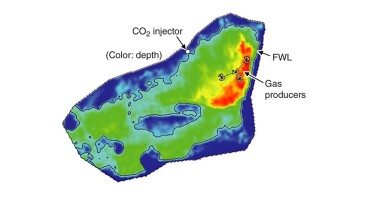
The authors of this paper present a workflow designed to achieve maximum integration between analytical and modeling activities in carbon capture and storage projects.
-
This month’s selections of unconventional technology articles investigate the factors affecting productivity and performance and highlight the need for effective strategies to enhance performance and mitigate impairment issues.
-
As US shale potentially stares at a production plateau, operators and service providers are turning to smarter tools to extend the life of aging plays.
-
The service giant shares how its new technology can sense rock properties 50 ft ahead of the bit in horizontal wells.
-
The authors present an efficient workflow using an embedded discrete fracture model to simulate carbon-dioxide flow by use of conductive faults.
-
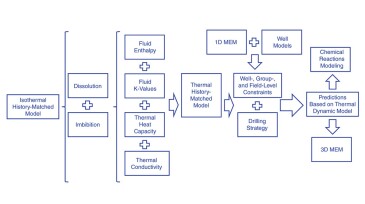
This paper provides guidelines for thermal modeling for carbon capture and storage projects in a depleted gas field.
-
The authors of this paper present an adaptive grid-coarsening approach based on constraints that honor reservoir structure and stratigraphy, preserve fluid volumes and contacts, and retain resolution near wells.
-
This paper investigates condensate-banking effects on well performance by conducting field-modeling studies on Delaware Basin deep Wolfcamp condensate producers using compositional simulation models with hydraulic fractures.
-
The SPE Reservoir Technical Discipline and Advisory Committee invite their Reservoir members worldwide to participate in a new survey aimed at assessing the current state of reservoir engineering across industry and academia. Deadline is 21 July 2025.