Reservoir

This paper aims to establish a set of best practices for generating particle-size-distribution data from core samples.

This paper discusses the successful execution of two openhole gravel-pack completions in two Gulf of Mexico fields with depleted reservoirs.

By integrating experimental and mathematical modeling approaches, this work aims to advance the understanding of sand-detachment dynamics and formation instability under varying saturation conditions.
-
 This paper describes a polymer-injection pilot in the Chichimene heavy oil field in Colombia.
 -
The companies have finished a seismic survey of an underexplored area of the Bonaparte Basin offshore northwest Australia.
-
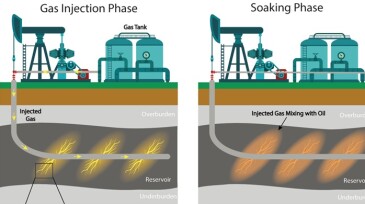
This paper presents a comprehensive literature review and critical examination of the published modeling and experimental studies regarding the recovery mechanisms of cyclic gas injection and the conditions under which the process can enhance oil recovery with the aim to identify lessons learned and areas in need of further study.
-
Machine learning and a decade of gas composition records helped the operator identify wells that were most likely to produce paraffins.
-
The third quarter marked the first reporting period that two publicly traded US oil and gas companies did not combine since 2022.
-
We’re thrilled to announce the launch of the 2025 SPE/JPT Drilling and Hydraulic Fracturing Technology Review. This exclusive, official publication will be distributed at three major SPE industry events.
-
Canadian Natural Resources strengthens its position as a leading oil and gas producer in Canada.
-
The agreement formalizes JV ownership of Turnwell Industries which ADNOC Drilling created to manage a $1.7 billion unconventional drilling contract awarded in May.
-
This paper presents the processes of identifying production enhancement opportunities, as well as the methodology used to identify underperforming candidates and analyze well-integrity issues, in a brownfield offshore Malaysia.
-
This paper presents a workflow that combines probabilistic modeling and deep-learning models trained on an ensemble of physics models to improve scalability and reliability for shale and tight-reservoir forecasting.