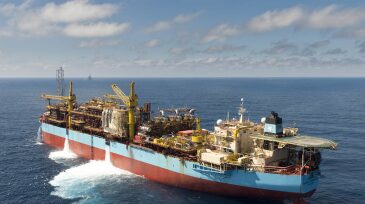
Floating production systems

With confidence in subsea boosting performance growing, BP is incorporating pumping systems into both greenfield developments and brownfield expansions.
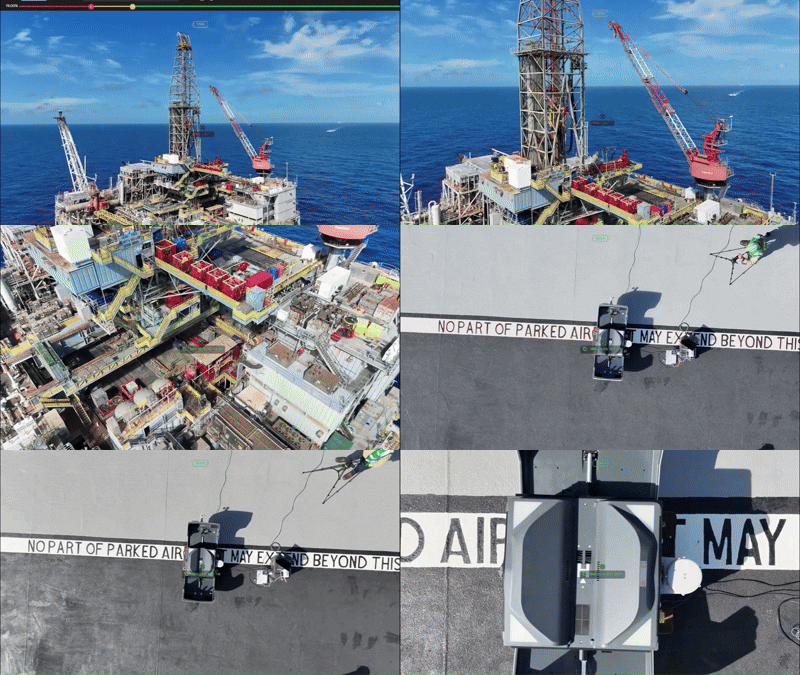
Shell has demonstrated drone-in-a-box operations from its Mars floating production unit, becoming the first operator in the region to secure FAA approval for self-approved offshore beyond-visual-line-of-sight flights. JPT Senior Technology Editor Jennifer Pallanich visited Shell Technology Center Houston to see the system in action.

This paper explores the application of a modular, high-temperature gas-cooled nuclear reactor to a Very Large Crude Carrier-class floating production, storage, and offloading vessel.
-
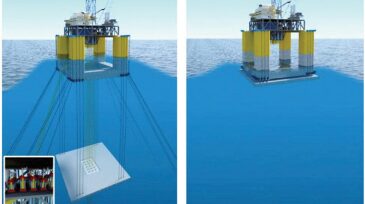
 Semisubmersible floating production systems (SFPSs) with steel catenary risers (SCRs) are attractive field-development solutions, especially in deeper water of Western Australia. However, SCR design is challenging in the offshore Western Australia environment because of severe cyclonic environments.
 -
A new type of organically modified silica glass that can remove a wide variety of oils and contaminants from produced and flowback water is showing promising results as it undergoes field trials.
-
Although the commissioning of a floating production system (FPS) generally takes place between the “mechanical completion” and “first oil” stages, commissioning activities begin long before then.
-
LLOG Exploration’s Delta House floating production system (FPS) looms large over Kiewit Offshore Services’ fabrication yard in Ingleside, Texas.
-
After severe damage in a typhoon, the Huizhou oil field in the South China Sea was back on production in 5.5 months. This paper reviews how this feat was accomplished.
-
The SPE Gulf Coast Section’s Project, Facilities, and Construction study group is hosting a series of lectures, “What Have We Learned About Host Selection in Deepwater GOM After 20 Years of Being Off the Shelf?
-
The market for floating production systems is growing rapidly, with spending from 2014-2018 expected to increase more than 100% from the prior 5-year period. Factors such as increased local content contribute to growing expenditures.
-
Roughly one-half of global gas reserves are considered stranded gas--uneconomical because of the remote location of potential markets, lack of economic transportation and infrastructure, or the lack of conversion technology. An FPSO with gas to liquids conversion is an option for stranded gas.
-
Good early production caused an FPSO to reach the design topside limit with only five wells connected. A study was undertaken to determine how bottlenecks could be reduced to allow greater production without compromising process safety.
-
Deepwater field developments are regarded as standard technology in several areas of the world, but in harsher environments, extreme design loads and increased fatigue loading become more challenging.