

Floating production systems

With confidence in subsea boosting performance growing, BP is incorporating pumping systems into both greenfield developments and brownfield expansions.
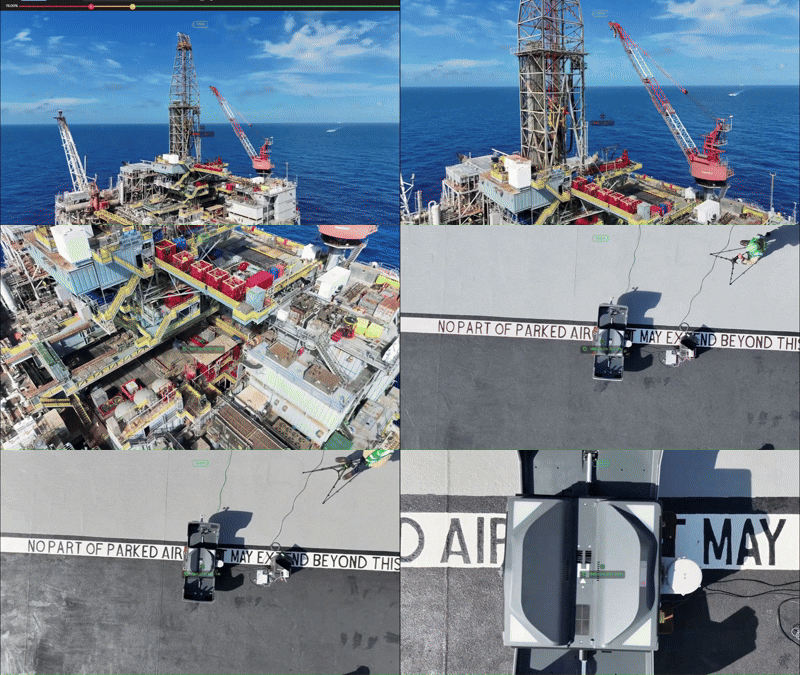
Shell has demonstrated drone-in-a-box operations from its Mars floating production unit, becoming the first operator in the region to secure FAA approval for self-approved offshore beyond-visual-line-of-sight flights. JPT Senior Technology Editor Jennifer Pallanich visited Shell Technology Center Houston to see the system in action.

This paper explores the application of a modular, high-temperature gas-cooled nuclear reactor to a Very Large Crude Carrier-class floating production, storage, and offloading vessel.
-
 After launching pre-salt production in Brazil, the ultradeepwater Tupi asset has become one of Petrobras’s most productive.
 -
The $5.1 billion ultradeepwater project is Angola’s first integrated cross-block development and sits at the top of Azule’s Southern African portfolio.
-
The Coral Norte FLNG is to be the mirror image of the Coral Sul unit, which shipped its first cargo in 2022 after it was put into service in Area 4 offshore Mozambique.
-
The new technology, recently highlighted at OTC, has received a statement of maturity from ABS.
-
Equinor said it found between 14 million and 24 million BOE with its most recent exploration well in the Polynya Tubåen prospect.
-
The project partners and the Newfoundland and Labrador government reach agreement over life-of-field benefits, royalties, and an equity option, moving development toward sanction in 2027.
-
Marking a major milestone as the Gulf of Mexico’s second 20,000-psi deepwater development, the project underscores how advanced high-pressure technology, management of flow challenges, and the floating production system’s role as a regional hub are helping open the door to more Inboard Wilcox development.
-
Despite a 2.8% drop in liquefied natural gas exports in 2025 because of lost market share in China, Australia anticipates a 2026 rebound as new North West Shelf capacity comes online. Meanwhile, East Coast operators brace for a tsunami of wells entering the decommissioning pipeline and potential energy shortfalls necessitating LNG imports.
-
Woodside’s $12-billion gas project offshore Western Australia is expected to produce up to 8 mtpa once it’s complete.
-
The platform brings the field’s installed production capacity to 1.5 million BOPD.



Page 1 of 25