Unconventional/complex reservoirs

Disposal wells remain the lowest-cost solution for produced water, but concerns over seismicity and long-term sustainability are accelerating interest in alternatives.

This work applies fuzzy logic, a well-established artificial-intelligence technique, to quantitatively assess connectivity between injectors and producers in a giant presalt field in the Santos Basin of Brazil.

With a strong presence across US shale in the Bakken, Anadarko Basin, Powder River Basin, and the Permian, Continental Resources is expanding into Argentina’s Vaca Muerta shale as the privately held E&P giant pursues international growth.
-
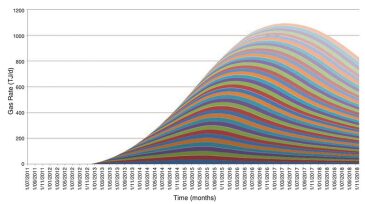
 Queensland, Australia, is currently host to a number of coal-seam-gas (CSG) to liquefied-natural-gas (LNG) projects under development.
 -
Surface jet pumps (SJPs) are simple, low-cost, passive devices that use a high-pressure (HP) fluid as the motive force to boost the pressure of produced-gas and -liquid phases.
-
The incredibly tight rocks that are the source of North America’s gas renaissance are off limits in Germany and France. Though Maersk drilled the first multifractured horizontal well in the North Sea in 1987, some European countries are now banning operations that have occurred legally for decades.
-
Drilling long horizontal wellbores and completing wells with multistage fracturing are common practices in shale-play development.
-
Hydraulically fracturing and stimulating multiple horizontal wells in sequence has been rapidly adopted by operators because of the potential for production without introducing unwanted risks.
-
At the Unconventional Resources Technology Conference in Denver, discussion revolved around solving problems below ground and above ground.
-
Matrix acidizing is commonly used as a preflush to the hydraulic-fracturing stimulation of shale formations. The process dissolves sediments and mud solids that inhibit the permeability of the rock, enlarging the natural pores of the reservoir and stimulating flow of hydrocarbons.
-
With the industry moving forward with exploration and development in the broader categories of unconventional resources globally, it is of paramount importance to assess and improve the different methods and tools for estimating reserves, to establish their accuracy and credibility.
-
There are no reliable estimates of technically recoverable resources (TRRs) for unconventional reservoirs outside North Amercia, and many countries lack the advanced technology such as horizontal drilling and hydraulic fracturing necessary to develop unconventional resources.
-
Flowback (or cleanup) of fracturing treatments can have a profound influence on well productivity in unconventional reservoirs. The process of cleanup crosses many discipline boundaries.