Unconventional/complex reservoirs

The deal for two Double Eagle subsidiaries adds 176,000 net acres in the Midland Basin and approximately 1,200 drilling locations.

Through the $1.77 billion deal, CNRL strengthens its Montney and Charlie Lake positions, while adding processing capacity and expanding its inventory of future development opportunities.
The UAE project is expected to produce up to 345 MMscf/D by 2029, with expansion potential to 1 Bcf/D.
-
 Canadian operator expands its Deep Basin gas footprint in Alberta, adding 700 new drilling locations.
-
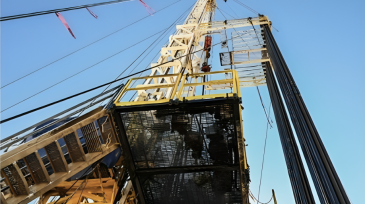
Turnwell said it achieved a new well delivery time as it begins a massive contract to develop the UAE’s unconventional gas resources.
-
A novel approach uses the heart-shaped signal in low-frequency distributed acoustic sensing measurements to estimate the hydraulic fracture tip distance before the hydraulic fracture intersects the monitor well, offering critical insight into the characterization of hydraulic fracture propagation.
-
At SPE’s Permian Basin Energy Conference, operators shared behind-the-scenes details on innovations such as drilling horseshoe wells and trimulfrac completions along with in-basin challenges such as handling produced water.
-
Operator acquiring oil-weighted New Mexico assets of both Franklin Mountain Energy and Avant Natural Resources.
-
The Denver-based independent is boosting its position in the Canadian shale play by 109,000 net acres, and about 70,000 BOE/D.
-
This paper presents a specialized workflow that aims to quantify the severity of condensate banking and subsequently optimize reservoir development strategies for a deep formation in the Permian Basin.
-
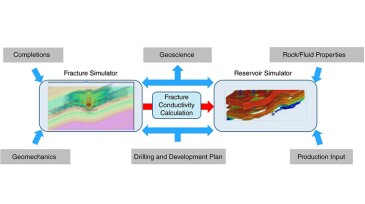
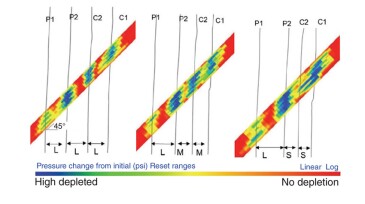
This paper describes numerical modeling studies of fracture-driven interactions using a coupled hydraulic-fracturing-propagation, reservoir-flow, and geomechanics tool.
-
This case study outlines a methodology to optimize and control hydraulic fracturing parameters by achieving 100% cluster efficiency and overcoming formation leak-off.
-
Machine learning and a decade of gas composition records helped the operator identify wells that were most likely to produce paraffins.