Unconventional/complex reservoirs

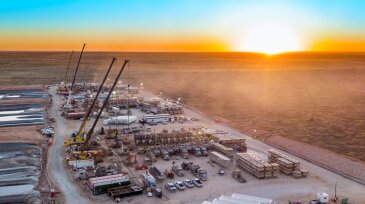
The deal for two Double Eagle subsidiaries adds 176,000 net acres in the Midland Basin and approximately 1,200 drilling locations.

Through the $1.77 billion deal, CNRL strengthens its Montney and Charlie Lake positions, while adding processing capacity and expanding its inventory of future development opportunities.
The UAE project is expected to produce up to 345 MMscf/D by 2029, with expansion potential to 1 Bcf/D.
-
 Incremental gains are not always celebrated, but as two of the biggest oil producers in the US show, they nonetheless can net unrealized savings and new efficiencies.
-
The combined company will have a strengthened position in the Permian Basin, and plans to operate 17 hydraulic fracturing fleets in the region.
-
Thousands of horizontal wells that had been drilled but uncompleted (DUCs) offered a way to maintain production without the cost of drilling more wells, but that resource is finally running low.
-
The third quarter has so far not seen any mergers and acquisitions in the shale business that top $1 billion.
-
The paper aims to determine the mechanisms of fracturing interference with multiwell pads in shale gas reservoirs and evaluate the effect of interwell fracturing interference on production.
-
This paper reviews innovations and technologies used to make the Atlanta field in the Santos Basin a successful case of heavy-oil production in ultradeep water.
-
The authors write that cyclic gas injection enhanced oil recovery for Eagle Ford volatile oil can yield substantial increases in estimated ultimate recovery.
-
A fast-moving pressure pulse is the priority of a research and development initiative that, if successful, will result in a new diagnostic technology for horizontal wells in tight reservoirs.
-
This paper describes an artificial-lift technology, a subsurface compressor system, that simultaneously removes liquids, increases gas production, and improves recoverable reserves in gas wells.
-
A 2-year study of a formation used for saltwater disposal in the Bakken may hold promise of decreasing the pressurization of the formation and increasing the reuse of the briny produced water.