Unconventional/complex reservoirs

Transaction adds 90,000 net acres and 68,000 BOE/D of production as Crescent expands its South Texas footprint.

This paper aims to establish a set of best practices for generating particle-size-distribution data from core samples.

This paper discusses the successful execution of two openhole gravel-pack completions in two Gulf of Mexico fields with depleted reservoirs.
-
 This paper presents a literature review to determine the engineering challenges and opportunities presented by CBM production in China.
 -
The Apollonia tight-gas chalk play is located in the Abu Gharadig Basin in the Western Desert of Egypt. This has long been ignored as a gas play in the overburden, while the Jurassic and Cretaceous oil fields deeper in the basin have been explored and developed.
-
This paper reviews the efforts to exploit CBM resources in Indonesia, the challenges these efforts have faced, and possible solutions that can make operations more efficient and profitable.
-
Saudi Aramco is tapping Halliburton’s expertise in developing unconventional resources to increase domestic gas production, a pillar of its long-term strategy.
-
Wells are starting to come on stronger than expected, which is putting a new emphasis on orginizing all the other ingredients needed for shale production: more rigs, roads, pipelines, water, and sand.
-
The complete paper proposes an azimuthal plane-wave-destruction (AzPWD) seismic-diffraction-imaging work flow to efficiently emphasize small-scale features associated with subsurface discontinuities such as faults, channel edges, and fracture swarms.
-
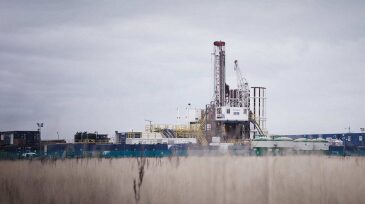
Overcoming numerous regulatory hurdles, Cuadrilla Resources is pressing ahead with its plans to fracture a well in the UK for the first time since 2011.
-
Shale gas is one of least sustainable options for producing electricity, according to new research from The University of Manchester, which considered environmental, economic, and social sustainability factors.
-
The objective of the complete paper is to present an integrated work flow that can be used to build P90, mean, and P10 type wells, which represent the range of potential outcomes for the geologic subset in an unconventional resource play.
-
After a drop in drilling activity in recent years, the Haynesville shale has become a hot area for natural gas production in the US, and companies are looking to bolster their positions in the area.