Water management
This paper presents an approach to the identification, selection, and implementation of initiatives for sustainable water management, withdrawal reduction, and water valorization.

Disposal wells remain the lowest-cost solution for produced water, but concerns over seismicity and long-term sustainability are accelerating interest in alternatives.

This article addresses the challenges of managing water-soluble organics (WSOs) in offshore produced water. It provides a brief discussion of the chemistry, along with strategies and technologies that can be used to manage WSO levels in produced water, thus facilitating compliance with regulatory overboard water-quality guidelines.
-
 A recent webinar focused on hydrocyclones and their application for offshore oil and water separation. The discussion includes fundamental science, practical considerations, implementation and field experience.
 -
Produced water is an inextricable part of the oil- and gas-recovery process, and it is by far the largest-volume waste stream associated with oil and gas recovery.
-
In terms of platform technologies and extraction strategies, there are fundamental differences between the North Sea and the deepwater Gulf of Mexico (GOM).
-
The objective of this paper is to detail how water quality and injection pressure are deduced when uncertainties of input data are considered.
-
Many strategies have been implemented to mitigate the problem of high water-production rates seen in mature fields.
-
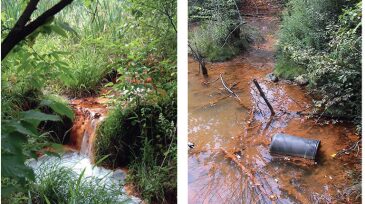
Polluted streams in Pennsylvania could provide a source of water for hydraulic fracturing and help prove a new way to clean up waterways contaminated by coal mine waste.
-
This is the fourth article of a series covering water management in hydraulic fracturing (HF) in unconventional resources. This article discusses the use of mechanical vapor compression (MVC) as a desalination technology.
-
A growing number of alternatives for treating flowback water enable operators to meet the requirements for discharge or reuse of the water in the fracturing fluid, a scientist said recently.
-
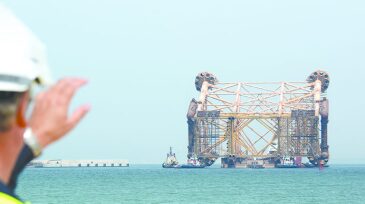
In one Saudi Aramco offshore oil field, the production from different platforms is transported to an onshore gas/oil-separation plant (GOSP) where the produced water is removed from the hydrocarbon stream.
-
Many segments of the oil and gas production industry need improvements in water filtration over traditional methods.