

Technical Section Editorial
JPT’s Technical Section Editorial series features insights from committee members across SPE’s technical sections. Articles examine technical priorities, key activities, and emerging challenges within specific disciplines, providing SPE members with clear insight into how industry experts and volunteers are helping define SPE’s technical direction. Collectively, the series reflects the depth of SPE’s technical community and its continued commitment to advancing knowledge-sharing across the upstream energy sector.
Learn more about the SPE Robotics and Autonomous Systems Technical Section on the RASTS SPE Connect Page.
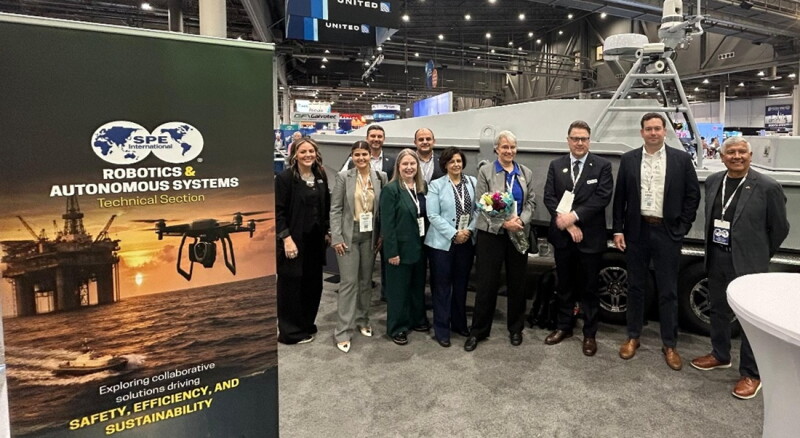
The 2026 Offshore Technology Conference (OTC) held in Houston marked a turning point for the SPE Robotics and Autonomous Systems Technical Section (RASTS), not because of any single announcement or product reveal, but because of where the conversations were happening. For the first time, RASTS had a dedicated booth on the conference floor. That shift in venue mattered. It moved the discussion on uncrewed and autonomous offshore technologies out of the session rooms and into direct contact with operators, engineers, and procurement professionals who make deployment decisions.
This article is a reflection on what that presence produced: what we heard, what stood out, and what it suggests about the direction the industry is heading.
The booth served as a meeting point for a technical section whose membership spans subsurface interpretation, facilities engineering, offshore operations, and digital integration. Visitors came from major operators, independent producers, university research groups, early-stage companies, and established service providers. The range of people who stopped to engage was telling. The question is no longer whether autonomous systems belong in offshore energy. It is how to put them to work, at scale, without breaking existing operational structures.
Platforms Doing Real Work
Among the autonomous technologies on display and discussed at OTC, a few things stood out as representative of where the field is now, not where it might be in 10 years. This is where RASTS had the opportunity to collaborate and showcase an autonomous underwater vehicle (AUV) called Eelume, provided by Arnt Olsen, based in Houston. The booth also showcased an autonomous surface vehicle (ASV), the 24-ft Corsair provided by Saronic and supported by the company’s Austin-based team led by Dan Redmon. Both platforms are currently doing work for the the US and Norwegian militaries but have dual-use applications yet to be fully exploited by the oil and gas industry.
On 5 June, one of Saronic’s Corsair ASVs conducted a rescue of two downed US helicopter pilots in the Sea of Oman, the first documented rescue by an autonomous vehicle.
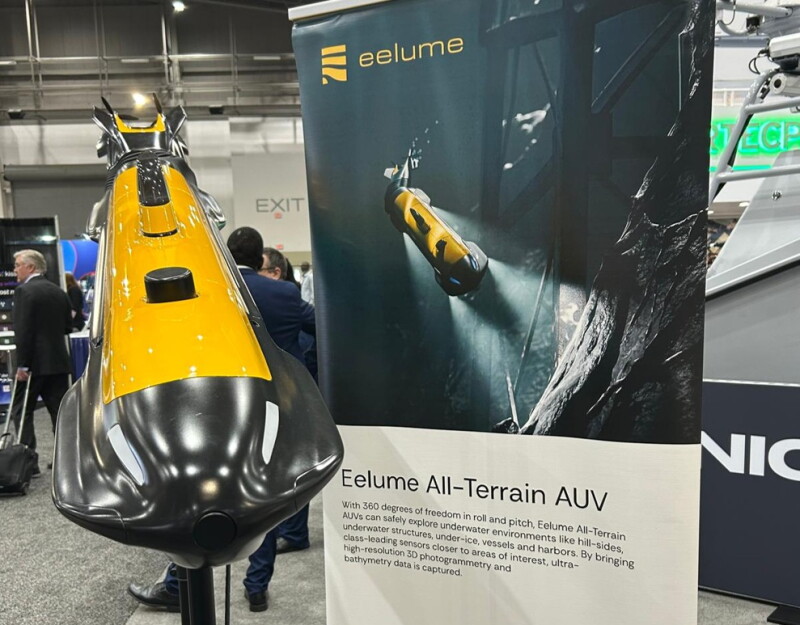
Conventional subsea inspection and light intervention work has always required surface vessel support. That dependency is beginning to loosen. At OTC, Eelume’s articulated autonomous underwater vehicle concepts designed to operate continuously from fixed subsea docking stations made a credible case that persistent, vessel-independent subsea capability is no longer theoretical. These systems can carry out routine inspections, anomaly detection, and limited intervention work on a continuous basis, cutting the reliance on surface vessels along with the associated fuel burn, emissions, and personnel exposure.
The hard engineering problems here go well beyond the vehicle itself. Power delivery, acoustic and radio frequency communication, reliable docking under real sea conditions, and compatibility with existing subsea infrastructure must all be solved together. The systems on display at OTC suggested those problems are being worked through in a practical manner, not just in concept.
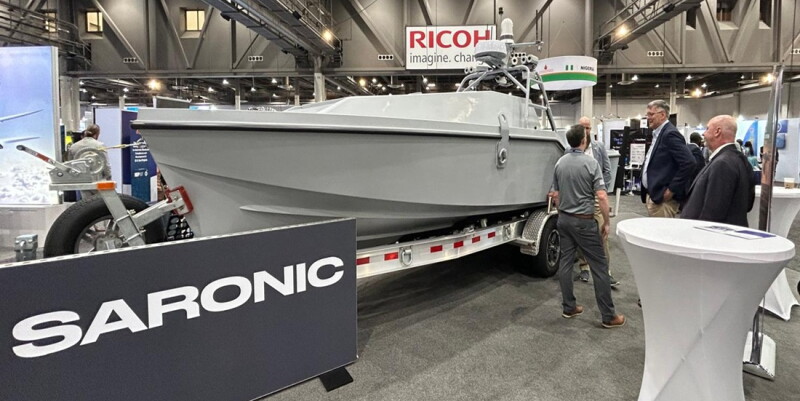
ASVs, previously associated mostly with military applications, surveys, and environmental monitoring work, are starting to move into offshore energy operations in a more direct way. The value proposition is straightforward: fewer personnel offshore, lower per-task operating costs at scale, and platforms that can be repositioned quickly and safely when operational priorities shift.
That transition raises practical questions that the conversation at OTC addressed but did not fully resolve, which is probably the right outcome for a conference floor. How do these vessels sit within existing maritime traffic management frameworks? What communication infrastructure do they require for continuous remote supervision? What does regulatory approval actually look like in different operating jurisdictions? These questions need operators, technology developers, and regulators in the same room, and OTC 2026 was a step toward that.
Fitting Into the Work That Already Exists
Perhaps a more significant conceptual point on display at OTC was a reframing of what autonomous systems actually do in an offshore context. The most persuasive technology demonstrations were not about what a single vehicle or system could do in isolation. They were about how sensor data from autonomous platforms gets routed into existing control room workflows, how inspection findings feed into integrity management processes without requiring manual data re-entry, and how remote operators can monitor multiple assets through a common interface without needing specialist training for each platform.
In this framing, autonomous systems are not a replacement for existing offshore workflows. They are an additional layer that makes those workflows faster, better informed, and less dependent on physical access. That resonated clearly with operators who have spent the past several years building out digital programs and are looking for ways to connect those investments to what happens on the asset.
Why the Value Shows Up at the Borders
One of the more energizing aspects of the booth experience was the range of professional backgrounds of the those who visited. Reservoir engineers were interested in what autonomous downhole tools might mean for data acquisition during production. Facilities engineers were working through how resident AUVs could change the economics of subsea integrity programs. Health, safety, and environment professionals were focused on the risk reduction case, taking people out of high-exposure environments entirely. Digital and data professionals were thinking through what the computational architecture needs to look like when managing a fleet of autonomous assets across multiple installations.
This cross-disciplinary character is not incidental to RASTS. It is fundamental to why the section exists. The governance structures required to manage them cut across operations, engineering, and digital departments. And the value they create appears at the intersections between inspection data and integrity modeling, between autonomous survey results and reservoir characterization, between real-time operational awareness and remote decision-making.
Where Industry, Academia, and Early-Stage Development Meet
OTC has always functioned partly as a technology marketplace where companies with new systems can get in front of potential operators. What stood out this year was the density of interaction across the full development spectrum. University groups working on autonomous underwater navigation and manipulation were present alongside early-stage companies developing novel propulsion and energy systems, established equipment providers adding autonomy to existing product lines, and major operators working through near-term deployment plans.
The RASTS booth created conditions for a particular kind of exchange that is hard to manufacture in formal session formats. When an operator describes a specific operational difficulty—say, reliable visual inspection of complex subsea geometry in low-visibility water—and a research group at the same event is working on exactly that problem, connecting those two conversations can compress years off a development timeline.
The Questions That Now Matter
The shift underway in offshore autonomy has practical consequences for what the RASTS community should be focused on. Many years ago, the central question was whether autonomous systems could perform offshore tasks reliably enough to be trusted at all. For a growing range of applications, that question has been answered. The questions that now matter are about scale, organizational readiness, governance, and safety.
- How are operators managing mixed fleets of autonomous assets across multiple installations?
- What skills and organizational structures are needed to support autonomous operations at a meaningful scale?
- How do we ensure the data generated by autonomous systems is actually used in decision-making rather than sitting unused in storage?
- What changes are needed in liability and insurance frameworks to support uncrewed offshore operations commercially?
The oil and gas industry has been on the verge of a technology transition so many times that the phrase has lost most of its meaning. What was different at OTC 2026 was the texture of the evidence. Pilot programs are moving to operational deployments. Technology readiness levels are rising across the board at a rate previously unseen.
These are not purely technical questions. They are organizational, regulatory, and commercial ones. Answering them well requires exactly the kind of broad, cross-disciplinary community that SPE is built to support.
The Way Forward
In one sense, RASTS's debut on the OTC floor was a small organizational step: a booth, two innovative autonomous platforms, some well-seasoned SPE professionals, student interns (all volunteers), and enlightening conversations. In another sense, it reflected something more consequential. That an industry that has worked through its initial uncertainty about autonomous offshore systems and is now focused on the practical work of putting them to use.
The problems ahead include scaling deployments, aligning regulatory frameworks, and building the organizational muscle to manage uncrewed assets day to day, but they are the right problems to be working on.

Thalya Robinson, SPE, holds an MS degree in energy engineering, specializing in renewable energy, and a bachelor of applied science degree in petroleum engineering, both from The University of Trinidad and Tobago. Her background spans sustainable energy development, renewable energy market analysis, and clean energy investment assessments, including experience in evaluating energy projects across Latin America and the Caribbean from technical, commercial, and country-risk perspectives. Robinson is an active volunteer with the SPE, holding roles as section secretary for the Trinidad and Tobago Section, communication and outreach officer for the Robotics and Autonomous Systems Technical Section, and vice administration chair for the Sustainable Development Technical Section.

Yasmin Sodré, SPE, holds a bachelor’s degree in industrial engineering and an MBA degree in oil and energies from the Federal University of Rio de Janeiro and certified as a Project Management Professional. She is a commercial project manager at Fugro, based in Houston, specializing in uncrewed surface vessels and offshore energy solutions, leading complex, high-impact projects across the Americas. With international experience in Brazil, India, and the US, Sodré excels at navigating regulatory frameworks, coordinating multicultural teams, and driving innovation in marine operations. She serves as program chair for the SPE Robotics and Autonomous Systems Technical Section.