Testing page for app
-
 The complete paper presents a large-scale work flow designed to take a vast amount of data into consideration. The work flow can be scaled for projects of any size, depending on the data available.
 -
An opportunity now exists to further develop the way we solve problems by adopting agile work flows. Originating from software development in 2001, agile work flows will be a key part of driving the oil and gas industry to its next level of efficiency.
-
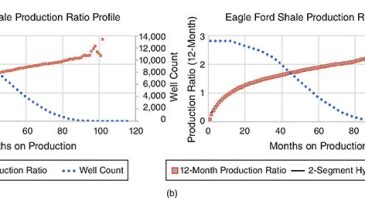
The complete paper discusses the use of cumulative production ratio curves normalized to a given reference volume in time for different unconventional plays in North America to investigate the median trend for each play and the median ultimate recovery per play.
-
In tectonically influenced regions, potential hydrocarbon traps are subject to complex states of stress. This scenario often translates into severe strike/slip (SS) and thrust-fault or reverse-fault (TF/RF) stress states.
-
What the industry needs at this stage is a willingness to work together, share best practices, conduct innovative research, and focus on disruptive technologies that lower cost of capture and make our operations more sustainable.
-
Of all the programs that SPE offers, the most rewarding and enjoyable ones for me personally are the conferences. I love walking the floor of an exhibition hall, discovering the latest technology advancements, and listening to the various product demonstrations.
-
Despite the global downturn, the long-term transition to net zero presents a major opportunity to create new multibillion industries based around the North Sea. Cross-sector collaboration and major state/private sector intervention, together with strong leadership, will be key.
-
While oil- and gas-related companies slash budgets and staff and operators pull back from production and exploration, the tax coffers of US local and state governments are shrinking fast and with hard repercussions.
-
A lot about the blowout preventers used for offshore drilling has changed since Macondo in 2010, but the essentials remain. This evolution serves as a case study on why some oilfield technology is hard to change.
-
Nearly everything’s on the table as companies aim to shore up portfolios by curtailing investments and dumping low-priority assets.