Testing page for app
-
 During the past 3 years, over half a million patents were granted for production monitoring. This progress has led to a shift toward integrated work flows, cloud-based platforms, resilient sensors, process simplification, and automation.
 -
The papers described here focus on novel unconventional horizontal downhole pump card signatures, carbon reduction through alternative energy to pump wells, and predicting downhole-discharge pressure of ESPs.
-
High-pressure/high-temperature (HP/HT) resources continue to be a focus of efforts to apply new technologies that maximize productivity while addressing concerns related to capital expenditure, operating expenses, and high drilling costs. These cost-effective technologies will only grow in importance in exploiting HP/HT and ultra-HP/HT fields.
-
The world of artificial lift has witnessed a remarkable revolution over the past 25 years, with many of the events and technology trends recorded in the Journal of Petroleum Technology.
-
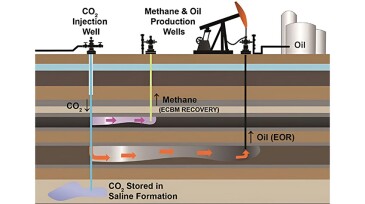
The long, successful history of various metallurgies in EOR wells has been cited as sufficient to allow the same completions for CCS injection wells. The lack of actual data on the long-term performance of these alloys in EOR wells in combination with the more-stringent requirements for Class VI wells suggests otherwise.
-
This paper presents the mitigation of drilling challenges encountered in the Niger Delta through a technique that relates shale resistivity to shale porosity and vertical effective stress to predict pore pressure.
-
This paper discusses a new type of mechanical gas separator for electrical submersible pump systems that increases operating flow range and separation efficiency while decreasing erosion problems and improving reliability.
-
This paper describes how near-real-time tracer data from the onsite tracer analysis enabled the operator of the Nova field to interactively optimize two well cleanups.
-
This work provides a new modeling tool, validated against a static-wellbore solver and field data, to estimate and manage downhole temperature in higher-temperature oil, gas, and geothermal wells.
-
Slickline-Deployed Fiber-Optic Cable Provides First Production Profile for High-Temperature Gas WellThis paper describes a case study in which, in the absence of a conventional production log, distributed fiber-optic sensing, in conjunction with shut-in temperature measurements, provided a viable method to derive inflow zonal distribution.