

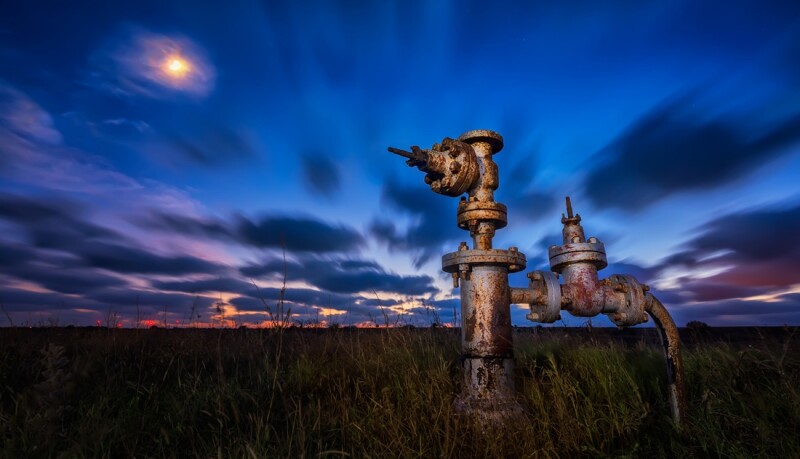
The Interstate Oil and Gas Compact Commission (IOGCC) records that more than 3 million idle wells must be plugged and abandoned in the US. Plugging and abandonment is a significant issue for the producers or states who eventually must bear the cost, but repurposing wells can take advantage of certain idle wells suitable for long-lasting isolation of spent nuclear fuel (SNF).
Deep borehole disposal of SNF in crystalline basement rock has been investigated by the US Department of Energy and the Sandia National Laboratory for decades. The studies included drilling expensive wells into volcanic and metamorphic rocks and potentially storing such wastes.
The novelty presented here is that, by repurposing and using the storage space of steel casing of certain deep oil and gas wells destined to be plugged and abandoned, more options can be created for many localities.
This work investigates temperature rise in sedimentary rock because of the thermal decay heat of disposed SNF. Rock welding and metamorphism in permanent isolation casings surrounded by sedimentary rocks may occur in temperature ranges of 200–600°C. The preference in geological barriers for deep borehole disposal in crystalline rock is for a form of “rock welding” by downhole electric heating that partially melts the crushed host rock and backfills and adjacent wall rock. For a granitic host, a temperature around 800°C should suffice, while recrystallization and metamorphism in sedimentary rock start at much lower temperatures and with a specific calculated heat generation by SNF. As such, there is no need for electric heating devices or high-temperature cement grouts. Higher porosity and permeability of sedimentary rock surrounding the casings in idle oil wells can provide an ideal situation for lower heat dissipation. The effect of heat flow in porous media has been widely investigated.
The authors modeled heat transfer in subsurface sedimentary rocks surrounding the casing, and preliminary modeling shows definitive results. The IOGCC database can be used to prepare a list for certain states, including Texas and Louisiana, of regions that include idle oil and gas wells. These wells can be screened on the basis of their wellbore configurations and drilling history to determine if they meet the expectations for waste storage.