

Latest News
-
 In industries where data is key to gaining competitive advantage, artificial intelligence and machine learning have become necessities. Tim Custer, senior vice president with Apache, shares how artificial intelligence is affecting the way the energy business operates.
 -
The oil and gas industry is increasingly characterized by complex connectivity, but our digital dependency brings a new realm of cyber risks. Are we cyber-ready?
-
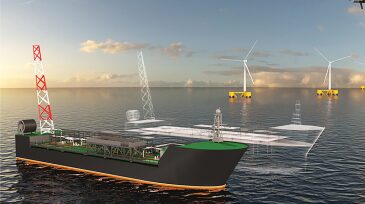
While it remains today only an idea, there are but a few barriers keeping an unmanned floater from being realized, according to one of the world’s leading offshore engineering firms.
-
Saudi Aramco has suspended the contract for the Seadrill co-owned jackup drilling rig for up to 1 year.
-
Malaysian oil company Petronas has hired Maersk Drilling’s rig Maersk Developer for a one-well exploration campaign off the coast of Suriname.
-
In 2004, US oil production was in decline, Facebook did not exist, and attitudes toward climate change were in flux. In years since, what has happened—and what’s important for the oil and gas industry of tomorrow?
-
Oil sands producers predicted they could reduce production by 300,000 B/D by turning down steam injection. This will test methods to reduce, rather than stop, injection to avoid the damage caused by rapid cooling in some wells.
-
Hydrogen is big news, and not for the first time. But this time could be different. This article looks at the current state of enabling technology, obstacles to a hydrogen economy, and signs that the hydrogen economy could be emerging.
-
A well was drilled into a prospective unconventional mudstone play offshore Norway. Two of five coring runs were successful while the rest yielded little to no core recovery. Subsequent investigation of the core substantiated that the coring issues largely had natural causes.
-
The traditional subsea tieback model is evolving, supported by advances in flow assurance that allow tiebacks over much longer distances and by the introduction of new technologies that increase overall cost effectiveness.
-
The E&P subsurface sector today faces the lowest reserve replacement ratios in decades as well as an increasing need to maximize recoverable oil and gas from developed fields.
-
Often it is too difficult to create the fault conditions necessary for training a predictive maintenance algorithm on the actual machine. A digital twin generates simulated failure data, which can then be used to design a fault-detection algorithm.






Explore Content by Discipline
Trending Content



Get JPT articles in your LinkedIn feed and stay current with oil and gas news and technology.