

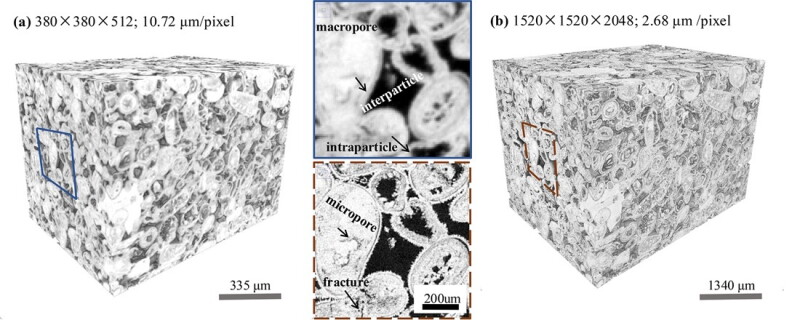
Carbonate rocks, as complex multiscale porous media, present major imaging challenges because of intricate structures and strong heterogeneity. To address the trade-off between field of view and resolution, we introduce the Swin transformer for image restoration generative adversarial network (SwinIRGAN), a super-resolution framework based on sliding-window attention that captures long-range features efficiently.
The model balances global consistency with high-frequency detail preservation and learns the mapping between low-resolution and high-resolution images.
Using a biogenic carbonate data set, SwinIRGAN achieves 99.48% accuracy in Euler’s number and 97.05% accuracy in higher-resolution extrapolation.
For the multiresolution complex carbonates micro-computed tomography (micro-CT) (MRCCM) data set, the proposed reconstruction and extrapolation workflow improves Euler’s number by 15.59% compared with the baseline.
Results show that SwinIRGAN preserves mineralogical and topological characteristics across scales and provides more reliable digital rocks for pore-scale analysis and flow simulation.
This abstract is taken from paper SPE 234678 by Y. Meng, College of Civil and Transportation Engineering, Eastern Institute of Technology and Imperial College London; K. Tang, University of New South Wales; H. Xie, College of Civil and Transportation Engineering; Z. Chen, Eastern Institute of Technology; Y. Teng, College of Civil and Transportation Engineering; Y. Chen, Eastern Institute of Technology; C. Li, College of Civil and Transportation Engineering; and S. An, College of Civil and Transportation Engineering and Imperial College London.The paper has been peer reviewed and is available as Open Access in SPE Journal on OnePetro.