AI/machine learning

As digital technologies become commonplace, industry leaders say core engineering knowledge remains essential for making informed decisions and avoiding costly mistakes.

The deals, with a potential value exceeding $3.7 billion, are aimed at strengthening Saudi Aramco’s supply chains and expanding its use of industrial artificial intelligence.

This work applies fuzzy logic, a well-established artificial-intelligence technique, to quantitatively assess connectivity between injectors and producers in a giant presalt field in the Santos Basin of Brazil.
-
 Advanced machine-learning methods combined with aspects of game theory are helping operators understand the drivers of water production and improve forecasting and economics in unconventional basins.
 -
Decline-curve analysis is one of the more widely used forms of data analysis that evaluates well behavior and forecasts production and reserves. This paper presents technologies that apply DCA methods to wells in an unbiased, systematic, intelligent, and automated fashion.
-
The complete paper discusses optimization of a development plan involving low-salinity water injection.
-
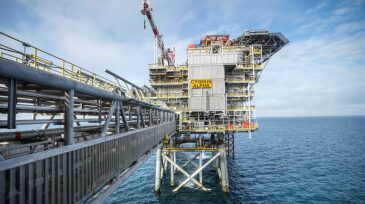
Using 3D and artificial intelligence technologies, a digital map of all three bridge-linked jackets was captured, enabling Neptune to detect asset-integrity issues early and plan fabric maintenance work on Cygnus.
-
Recent advances in data technology and machine learning have disrupted many businesses and processes and can lead to a new paradigm in workplace safety as well. This case study demonstrates the application of data science and predictive analytics to aid the health, safety, and environment function.
-
This story reviews well-adopted ideas that have stood the test of time, presenting a small set of techniques that covers a lot of basic knowledge necessary to understand modern deep learning research.
-
In industries where data is key to gaining competitive advantage, artificial intelligence and machine learning have become necessities. Tim Custer, senior vice president with Apache, shares how artificial intelligence is affecting the way the energy business operates.
-
An intelligent drilling optimization application performs as an adaptive autodriller. In the Marcellus Shale, ROP improved 61% and 39% and drilling performance, measured as hours on bottom, improved 25%.
-
The 5-year effort will take advantage of Microsoft technologies in machine learning, augmented reality, user interactions, and the industrial Internet of things to deliver integrated solutions to the upstream industry.
-
This policy brief explores the key issues in attempting to improve cybersecurity and safety for artificial intelligence as well as roles for policymakers in helping address these challenges.