Data & Analytics

Shell has demonstrated drone-in-a-box operations from its Mars floating production unit, becoming the first operator in the region to secure FAA approval for self-approved offshore beyond-visual-line-of-sight flights. JPT Senior Technology Editor Jennifer Pallanich visited Shell Technology Center Houston to see the system in action.

Panelists at the SPE Subsea Well Intervention Symposium discussed where AI is delivering value today, where risks remain, and how engineers can best determine its usefulness.

As digital technologies become commonplace, industry leaders say core engineering knowledge remains essential for making informed decisions and avoiding costly mistakes.
-
 For thin-oil-rim reservoirs, well placement, well type, well path, and the completion methods must be evaluated with close integration of key reservoir and production-engineering considerations.
 -
The big data approach will allow new types of data-driven models to bypass traditional bottlenecks. It is also expected to lead to different views of standard models, thus providing new and valuable insights in the process.
-
Many business and digital corporations claim that between 100 billion and 200 billion devices could be connected by 2020.
-
A data-driven approach to successfully analyze and evaluate production-fluid impact during facility system divert events is presented. The work flow effectively identifies opportunities for prompt event mitigation and system optimization.
-
Failure to prioritize objectives and improper selection of candidate wells can have significant implications for both derived value and potential risk.
-
Data mining for production optimization in unconventional reservoirs brings together data from multiple sources with varying levels of aggregation, detail, and quality.
-
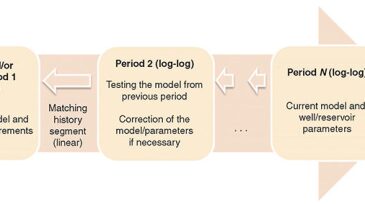
Permanent downhole gauges (PDGs) provide vast amounts of pressure-transient and rate data which may be interpreted with improved pressure-transient-analysis (PTA) approaches to gain more knowledge about reservoir dynamics.
-
This paper proposes a framework based on proxies and rejection sampling (filtering) to perform multiple history-matching runs with a manageable number of reservoir simulations.
-
The challenges facing the oil and gas industry require crossover technologies from other industries such as aerospace, automotive, and medicine to help drive efficiency, boost productivity, and optimize performance.
-
This paper describes the development of “digital-rocks” technology, in which high-resolution 3D image data are used in conjunction with advanced modeling and simulation methods to measure petrophysical rock properties.