Data & Analytics

Working with Dell Technologies and NVIDIA, the French supermajor is targeting improved seismic processing and artificial intelligence applications.

A discussion at the inaugural executive breakfast convened by the SPE Data Science and Engineering Analytics Technical Section, held alongside CERAWeek by S&P Global and powered by Black & Veatch, tackled the challenge of value creation from artificial intelligence in the energy industry.

AI‑driven data center growth is straining US power grids and accelerating interest in enhanced geothermal systems as a scalable, low‑carbon solution.
-
 SPE’s 2021 Open Subsurface workshop tackled the ins and outs of open source, open data, and open access.
 -
For the foreseeable future, going beyond the barrel will really mean maximizing returns from the barrel, including the identification and harnessing of potential gains from capital planning, asset management, and operations.
-
The goal of this paper is to aid oilfield security planning and design processes through improved recognition of the cyber-physical security effects arising from the implementation of the industrial Internet of Things.
-
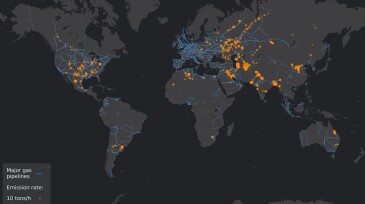
Thousands of satellite images were scrutinized by monitoring company Kayrros to identify ultra-emitters of methane, greenhouse-gas sources that cannot be detected by terrestrial monitors. Up to 150 methane plumes a month were seen, some spreading for hundreds of kilometers.
-
TAQ Energy, an oilfield abandonment service company, and Engage Mobilize announced a partnership to develop a cloud-based operational and financial platform.
-
Accenture was selected by Aker BP to develop a data factory in collaboration with Cognite. The cloud-based project has the goal of digitalizing the full lifecycle of the company’s operations to cut costs, improve productivity, and lower its carbon footprint.
-
The authors describe an integrated multiscale data methodology involving machine-leaning tools applied to the Late Jurassic Upper Jubaila formation outcrop data.
-
This paper describes the application of a synthetic seismic-catalog-generation method followed by application of a neural network on a seismic data set for an oil-producing field in the North Sea.
-
In this work, a methodology to detect interference from long-term pressure and flow-rate data is developed using multiresolution analysis in combination with machine-learning algorithms.
-
SponsoredImprove decision making and reduce the uncertainty of CCS projects with accurate, detailed subsurface insights that help you estimate storage capacity, run play chance mapping, improve your injection strategy, and simulate carbon plumes over time.