Drilling

This paper aims to establish a set of best practices for generating particle-size-distribution data from core samples.

This paper discusses the successful execution of two openhole gravel-pack completions in two Gulf of Mexico fields with depleted reservoirs.

This edition highlights three offshore technology papers that address a common industry theme: how targeted engineering solutions can reduce uncertainty, shorten operations, and make technically constrained offshore well activities more executable.
-
 Plug-and-abandonment (P&A) operations can be expensive, leading to negative net present value. Historically, P&A operations in the North Sea—estimated to hold some 3,000 wells of declining production—were performed with either drilling or workover rigs.
 -
The complete paper describes a recent directional coiled-tubing drilling (DCTD) job completed for an independent operator in the Appalachian Basin.
-
Shell made its sixth discovery from the Norphlet formation in the deepwater Gulf of Mexico, where the firm’s newly arrived Appomattox platform just 13 miles away presents a tieback opportunity.
-
UK’s active 30th Licensing Round resulted in the award of 123 licenses to a diverse set of 61 companies—an outcome that UK government officials hailed as more proof that interest is picking up in the aging North Sea.
-
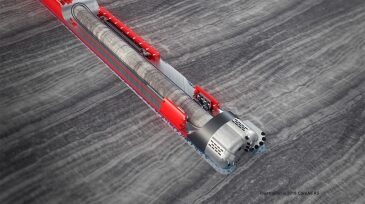
CoreAll's Intelligent Coring System uses a suite of sensors to analyze reservoir cores samples as they are being acquired, and a communication system that sends these data to the rig in real-time.
-
Coring is essential to offshore exploration programs—but sometimes cores are taken from the wrong formation or return to surface in poor condition. One firm thinks it can solve these costly issues with a first-of-a-kind coring device that uses logging instruments that add accuracy and integrity.
-
The Bureau of Safety and Environmental Enforcement is proposing to update regulations covering offshore oil and gas drilling operations.
-
Stories from the IADC/SPE Drilling Conference look at how the next generation of engineers is performing, the hottest well ever drilled, and the art of translating drilling numbers into executive reports.
-
As leaders in digital drilling analysis push into real-time data analysis and digital controls, they are finally confronting data-quality problems. Humans are better than machines at dealing with ambiguous readings.
-
Sensor technology in the oil industry changes infrequently. Improvements in MEMS sensor technology are creating rapid momentum toward the use of tiny, rugged, and inexpensive sensors to replace larger, costlier, and more fragile legacy-technology sensors in directional drilling.