Drilling

This edition highlights three offshore technology papers that address a common industry theme: how targeted engineering solutions can reduce uncertainty, shorten operations, and make technically constrained offshore well activities more executable.

This paper aims to establish a set of best practices for generating particle-size-distribution data from core samples.

This paper discusses the successful execution of two openhole gravel-pack completions in two Gulf of Mexico fields with depleted reservoirs.
-
 For the development of the Dvalin high-pressure/high-temperature (HP/HT) gas field in the Norwegian Sea, a completion scheme using standalone screens is planned.
 -
Wells in deepwater reservoirs show significant rate decline with time as the result of various causes. A diagnostic tool for quantification of factors influencing well-productivity decline is presented in this paper.
-
The success of water-conformance operations often depends on clear identification of the water-production mechanism. Such assessment can be complicated significantly when formation damage is also occurring.
-
SponsoredRunning casing to depth in long lateral sections is challenging, often costing operators a significant portion of pay zone at the toe of the well. This article highlights a technology that helped one operator add $120,000 to its incremental gas recovery.
-
This case study discusses the methodology that underlies the successful determination of the depths and the radial locations in the outer casing strings of multiple leaks in an offshore well.
-
This paper focuses on the preparation for, and implementation of, well-control training, while highlighting the integration of people skills into curricula and what advantages operators and drilling contractors have obtained.
-
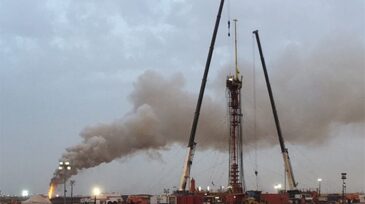
This paper describes the mobilization of a snubbing unit and blowout preventer (BOP) stack in the Middle East that enabled a well with an underground blowout and surface broaching to be brought under control within a short time.
-
Directional drilling and measurement-while-drilling technology has become so democratized in the Texas shale sector that no provider holds more than 8% of the market share.
-
Three appraisal wells drilled this year—GTA-1, Yakaar-2, and Orca-1—targeted nine hydrocarbon-bearing zones, encountering gas in high-quality reservoirs in all zones and yielding a combined 160 m of net pay.
-
Under the agreement, the Oklahoma City independent will monetize half of its working interest in 133 undrilled locations in the form of a $100-million drilling carry during the next 4 years.