Drilling

This paper aims to establish a set of best practices for generating particle-size-distribution data from core samples.

This paper discusses the successful execution of two openhole gravel-pack completions in two Gulf of Mexico fields with depleted reservoirs.

This edition highlights three offshore technology papers that address a common industry theme: how targeted engineering solutions can reduce uncertainty, shorten operations, and make technically constrained offshore well activities more executable.
-
 This paper presents a set of equations that extends the approach of the original single-shouldered equation to account for a second shoulder, and helps to understand connection strengths better.
 -
Energy consultancy Wood Mackenzie estimates the find holds some 2 Tcf of gas, making it this year’s seventh-largest discovery worldwide.
-
Operator Talos Energy now believes Zama’s gross recoverable resource lies in the upper half of its pre-appraisal estimate of 400–800 million BOE. The consortium is working toward a 2020 final investment decision on the project.
-
Regulators say the blowout that killed five workers on a Patterson-UTI rig in Oklahoma was the product of a slow-moving series of missed signals, misleading testing, and miscalculations that failed to control a natural gas influx.
-
SponsoredWell delivery scheduling is a complex and critical process, with substantial economic impact. It is often done manually using unsophisticated software tools. Actenum Upstream software overcomes the limitations of manual scheduling and is designed for operators and complex operations.
-
After drilling the Dorado-2 appraisal well, operator Santos Energy now expects a big increase in gas resources from predrill estimates, adding to one of the largest oil resources ever found on Australia’s North West Shelf.
-
The Agidigbo find follows the Kalimba, Afoxé, Agogo, and Ndungu discoveries. The five discoveries combined hold an estimated 1.8 billion bbl of light oil in place.
-
As the country pushes for higher output from its emerging unconventional sector, nature is pushing back. To get better results, operators there are increasing their reliance on technology.
-
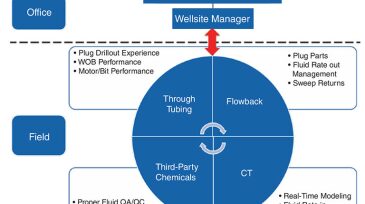
This paper presents a factory-model approach to improving CT drillout performance that has been used successfully for more than 3 years and has become standard practice.
-
Norway’s oil and gas major, Equinor, made headlines in October 2018 following its launch of the world’s first fully automated wellhead platform, the Oseberg H. Here, Claudia Jarrett, US country manager of parts supplier EU Automation, explains the challenges of unmanned automation in oil and gas.