Drilling

Sponsored
This case study by CNOOC and Halliburton highlights how enhanced multizone sand control treats eight unequal zones in one trip and reduces completion time by 60 hours in Bohai Bay, China.

US buyers are looking for extra shale inventory and added another $18 billion in purchases in October alone.

This paper presents the application of degradable particulate-diverter technology to improve oil production by effectively diverting stimulation treatment fluids away from high-water-cut, high-permeability, high-temperature producing intervals or zones.
-
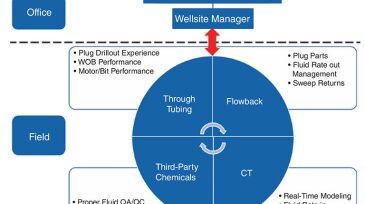
 This paper presents a factory-model approach to improving CT drillout performance that has been used successfully for more than 3 years and has become standard practice.
-
Norway’s oil and gas major, Equinor, made headlines in October 2018 following its launch of the world’s first fully automated wellhead platform, the Oseberg H. Here, Claudia Jarrett, US country manager of parts supplier EU Automation, explains the challenges of unmanned automation in oil and gas.
-
The biggest drilling company appears interested in becoming the most innovative. It is testing inventions ranging from a blowout preventer that is not hydraulically powered to power systems designed like a hybrid car.
-
When a rig is stacked, its owner has two choices: spend millions to keep it in good shape, or let it rust out. These two companies describe what it is like to maintain their assets for the day that a contract comes.
-
Leaders from UK’s Oil and Gas Authority, Total, CNOOC, and Equinor discuss exploration successes, misses, and expectations for the offshore UK.
-
This paper explains how an ultradeepwater drilling contractor is applying real-time analytics and machine learning to leverage its real-time operations center to improve process safety and performance.
-
A major operator manages multiple deepwater projects in the Gulf of Guinea. This paper describes one of these, a recent 44-well project.
-
Hydraulic isolation of wells drilled with nonaqueous fluids (NAFs) relies heavily on eliminating mud from the annuli before placing cement.
-
This paper demonstrates a new way to create gas-tight seals during well abandonment, overcoming the limitations of traditional methods and reducing the operator’s liability and potential environmental impact after decommissioning has been completed.
-
I am encouraged that we, as an industy, continue to refine and tweak our practices to solve zonal-isolation and cementing challenges in every well environment in which we work. As cementing techniques are improved, so, too, are the cement-evaluation methods and work flows.