Drilling

The deal expands TotalEnergies' exposure to US deepwater exploration acreage in the Green Canyon and Walker Ridge areas.

Industry forecasts point to increasing upstream expenditure and production, even as geopolitical volatility and smaller discoveries challenge project economics.

Industry fundamentals continue to strengthen as rising utilization and scarce replacement capacity support higher rig valuations.
-
 The complete paper discusses a new performance-evaluation methodology that combines bottomhole assembly (BHA) modeling with field data.
-
The complete paper presents a methodology designed for optimally matching drill bits, mud motors, and bottomhole-assembly components for reduced failure risks and improved drilling performance.
-
This paper explores the nature of the vibrational dysfunction known as BHA chatter. A field-proven frequency-domain model illustrates the cause of the dysfunction, its rotary-speed dependence, and mitigation methods and results.
-
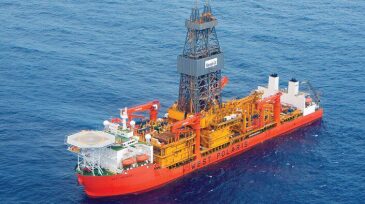
The London-based company is seeking to restructure more than $3 billion in debt as it struggles to find work for its offshore fleet.
-
Achieving and sustaining performance drilling’s intended benefits—improved drilling efficiency with minimal downhole tool failures and the associated reductions in project cycle time and operational costs—requires new protocols in drilling-system analysis.
-
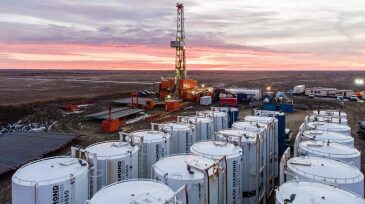
A Canadian company reports that it has drilled and completed a historic horizontal well in Saskatchewan.
-
Through the end of October, 38 rigs have been retired this year. Predicting future rig attrition is not an exact science, but certain metrics help identify those rigs.
-
There is a growing interest in using nanocomposites to improve drilling-fluid rheology. In recent years, an additive derived from a sequence of graphene-based materials has been reported. The progress of these graphene derivatives has been used as a paradigm for water-based drilling fluids.
-
Digitalization and automation successes are here to stay. Instead of making small incremental steps in well construction operations, allowing disruptive shifts can lead to tangible performance gains in efficiency, safety, and well integrity.
-
Advances during the past decade in using convolutional neural networks for visual recognition of discriminately different objects means that now object recognition can be achieved to a significant extent.