Drilling

This edition highlights three offshore technology papers that address a common industry theme: how targeted engineering solutions can reduce uncertainty, shorten operations, and make technically constrained offshore well activities more executable.

This paper aims to establish a set of best practices for generating particle-size-distribution data from core samples.

This paper discusses the successful execution of two openhole gravel-pack completions in two Gulf of Mexico fields with depleted reservoirs.
-
 Operators at a UAE field experienced several challenges while cementing production sections. A systematic approach was applied that used standard cementing best practices as a starting point.
 -
This paper discusses the successful design, laboratory testing, and performance of an innovative, low-solids, organophilic-clay-free invert-emulsion fluid (OCF-IEF) used to drill the reservoir section of an extended-reach-drilling (ERD) well.
-
Current long-reach technology already has a large effect on oil recovery. Many possible improvements, however, remain, and we see new contributions every year.
-
The Peregrino project, located in the post-salt zone of the Campos Basin, presents immense challenges for drilling extended-reach wells. This paper shares challenges imposed by the well profile and downhole environment on the design and execution phases.
-
This paper presents a concept that enables simultaneous drilling and completion, with an aim to extend well reach substantially and with an ultimate objective of constructing 30-km-long production wells.
-
Stories from the IADC/SPE Drilling Conference look at how the next generation of engineers is performing, the hottest well ever drilled, and the art of translating drilling numbers into executive reports.
-
As leaders in digital drilling analysis push into real-time data analysis and digital controls, they are finally confronting data-quality problems. Humans are better than machines at dealing with ambiguous readings.
-
Sensor technology in the oil industry changes infrequently. Improvements in MEMS sensor technology are creating rapid momentum toward the use of tiny, rugged, and inexpensive sensors to replace larger, costlier, and more fragile legacy-technology sensors in directional drilling.
-
As the resources that the industry develops become increasingly challenging, access to a broader range of options and new and developing approaches allows more-efficient and -effective recovery.
-
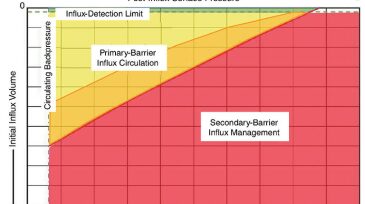
The influx-management-envelope (IME) concept is an advanced, innovative way to assess influx conditions in managed-pressure-drilling (MPD) operations, offering an improved tool for the decision-making process.