Drilling

This edition highlights three offshore technology papers that address a common industry theme: how targeted engineering solutions can reduce uncertainty, shorten operations, and make technically constrained offshore well activities more executable.

This paper aims to establish a set of best practices for generating particle-size-distribution data from core samples.

This paper discusses the successful execution of two openhole gravel-pack completions in two Gulf of Mexico fields with depleted reservoirs.
-
 The development of multilateral wells and long-reach wells has become important to maximizing recovery for many oil fields.
 -
One approach to refracturing involves the use of mechanical diverters such as perforation balls and rock salts, which may be useful for one stage; however, cessation of pumping operations results in these diverters falling out of the perforations or dissolving.
-
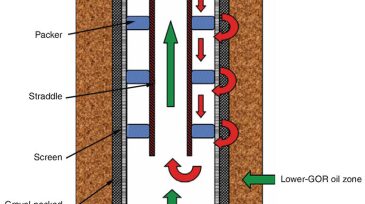
An operator successfully executed two wireline through-tubing gas-shutoff (GSO) workovers in high-angle openhole-gravel-pack (OHGP) completions to isolate high-gas/oil-ratio (HGOR) zones, resulting in significantly increased oil production.
-
One of the defining features of the 21st century will undoubtedly be the changing relationship between humans and automated machines.
-
Looking after the human factors in daily operations is good business because it increases employee safety and improves work performance.
-
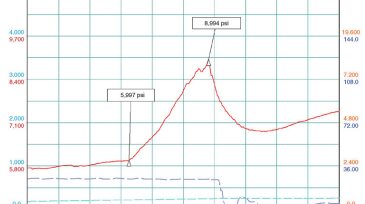
This paper describes the planning and execution of use of mud-cap fluid in the drilling of an ultranarrow-margin (0.50-lbm/gal window at the planning stage) high-pressure/high-temperature (HP/HT) well from a jackup rig.
-
The development of conventional reservoirs has typically involved minimal logging-while-drilling (LWD) technology, usually consisting of survey, gamma ray, and possibly resistivity tools.
-
A new measurement-while-drilling (MWD) tool has been designed that can operate reliably at 200°C and 207 MPa, providing real-time direction and inclination surveys, azimuthal gamma ray, annular and internal pressure while drilling, and shock and vibration measurements.
-
The Burgan reservoir consists of vertically stacked channel sands along with a fault network connected to the aquifer and contains highly viscous reservoir fluid.
-
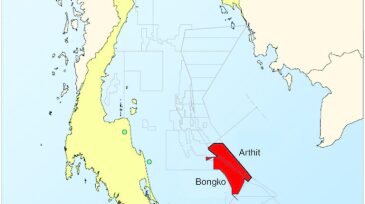
The paper discusses two gas/condensate-development projects offshore Vietnam that deploy managed-pressure-drilling (MPD) technology.