Energy transition

This guest editorial addresses the many capacities in which oil and gas technical professionals can play a role advancing the energy technologies of tomorrow.

With millions of wells having been drilled in the US since the beginning of the oil age, the land is pocked with old, unused wellbores. For most, repurposing is a pipe dream. Plugging is the best option.

The DOE-backed EGS-Twin project aims to simulate geothermal production systems, helping operators better predict performance and maximize output.
-
 Controversial metals-rich nodules sitting on the seafloor could hold the key to increased battery production needed to support the energy transition.
 -
The upstream oil and gas industry continues to drive innovation in its quest to solve the monumental challenge of supplying energy to the world in an affordable, secure, and sustainable way.
-
An energy transition symposium was held in February in Washington, DC, to inform and engage policymakers and the policy community in the US capital from the perspective of the engineers and geoscientists who currently work to supply 60% of the world’s energy.
-
High energy prices and a greater focus on energy security will not slow the world’s long-term ambition for a low‑carbon future. However, annual analysis by DNV believes unprecedented pressure is reinforcing a two‑speed energy transition.
-
The authors of this paper discuss deep closed-loop geothermal systems as an alternative to traditional enhanced geothermal systems for green energy production that is globally scalable and dispatchable.
-
The gathering’s goal is to install 120 GW of wind power in the North Sea by 2030.
-
Several options exist for large-scale hydrogen underground storage: lined caverns, salt domes, saline aquifers, and depleted oil/gas reservoirs. In this paper, a commercial reservoir simulator was used to model cyclic injection/withdrawal from saline aquifers and depleted oil/gas reservoirs. The results revealed the need to contain the stored volume with an integrated…
-
Also: A report says Bitcoin mining could ease emissions. Haliburton is accelerating its clean-energy efforts, while insurer Chubb cracks down on methane. ExxonMobil and Linde team up in Texas. Shell plans to limit CO2 emissions in Dutch plants, and Drax presses pause on bioenergy in the UK.
-
The large US shale producer has officially entered into the renewable energy sector with its largest venture investment yet.
-
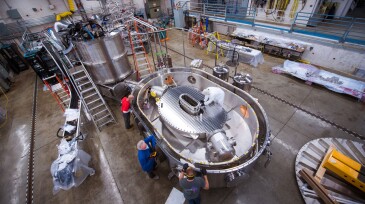
The strategic agreement puts the partners’ joint activities on a more certain path to connecting the first fusion power plant based on magnetic confinement to the electrical grid by early 2030.