Formation evaluation

This paper presents the methodology for developing drill-in organophilic clay-free invert-emulsion-fluid technology that enhances well production through fundamental geological studies and fluid testing.

Canada’s development of large-scale digital drilling core libraries and open geoscience data platforms follows approaches pioneered in Australia, particularly Western Australia, through decades of government investment in geoscience data collection and preservation.
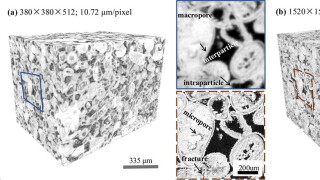
Imaging carbonate rocks at high resolution without losing scale has long been a challenge. A novel framework is introduced that enables accurate super-resolution and extrapolation of carbonate rock images, enhancing micro-CT images while preserving mineralogical and topological features for more reliable pore-scale analysis and flow simulations.
-
 An openhole advanced formation-evaluation approach is presented that enables assessment of tight-matrix and natural-fracture systems at a level not previously accomplished.
-
The interpretation of well tests, combined with petrophysical analysis, formation-test data, and production logs, provided insight into Khuff reservoirs.
-
The paper outlines examples from tight gas reservoirs in two fields in which openhole data was unavailable and petrophysical analysis was undertaken using cased-hole data.
-
The papers explore innovative approaches developed by authors of SPE conference papers toward avoiding data bias, working around the absence of openhole data, and reducing the uncertainty of mass-transport complexes.
-
Individually and collectively, we are currently facing undeniable difficult times. But, as has been said, challenges are also opportunities. It is a proper time for all of us to pause a bit and formulate way-forward plans that suit our needs.
-
A well was drilled into a prospective unconventional mudstone play offshore Norway. Two of five coring runs were successful while the rest yielded little to no core recovery. Subsequent investigation of the core substantiated that the coring issues largely had natural causes.
-
This paper introduces a new core-analysis work flow for determining resistivity index (RI), formation factor (FF), and other petrophysical properties directly from an as-received (AR) set of core samples.
-
Formation evaluation drew special attention at the 2019 International Petroleum Technology Conference Education Week in Beijing, 24–28 March 2019. The student team that worked on Integrated Formation Evaluation for Resources Exploration and Reservoir Delineation won the first-place award.
-
This paper bridges the gap between operational petrophysicists and FTS specialists, introducing an automated work flow by which petrophysicists can conduct FTS jobs.
-
What effects will Industrial Revolution 4.0 have on the upstream oil and gas businesses in general and petrophysics in particular? We should see more intelligence and automation in measurements, processes, work flows, and operations.