Fracturing/pressure pumping

The Seismos full-scale research center opens to industry, universities, and national laboratories, advancing acoustic sensing across upstream energy, pipelines, critical infrastructure, and national security.

This article from the SPE Research and Development Technical Section offers new insights to how the upstream industry can benefit from the emergence of quantum computing.

This contributed article highlights the growing importance of fiber-optic sensing and its potential to advance thanks to emerging quantum technologies.
-
 Refracturing older unconventional wells is likely to reward those willing to investigate the reasons why production declines and what can be done to restore it, according to George King, distinguished engineering adviser at Apache Corp.
 -
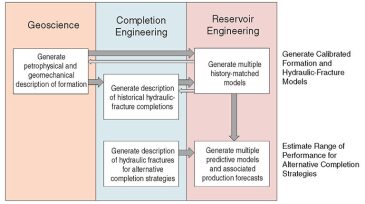
This paper describes a modeling technique by which hydraulic fractures are represented as part of the well model rather than as any form of refinement in the simulation grid.
-
This paper presents a pragmatic integrated work flow used to optimize development and guide critical development decisions in the Black Hawk field.
-
This paper discusses fracture stimulation in the first joint-venture shale-gas project with foreign companies in China.
-
Used extensively by the food, chemical, and pharmaceutical industries, the mechanical-vapor-recompression (MVR) process is viewed as a reliable method for recovering demineralized water from concentrated brines. This paper reports on performance of an advanced MVR system in north-central Texas.
-
Pumping fracturing jobs is an equipment killer. The job requires running enormous quantities of water and sand through a pump, which is an abrasive mix that damages pumps in ways that cannot be fixed. Adding to the pressure is the trend toward clustering wells on pad sites that extend run time.
-
A growing chorus of suppliers, researchers, and service companies is persuading US operators to re-examine their use of slickwater in shale plays and consider displacing it with carbon dioxide and nitrogen.
-
Hydraulic fracturing solutions use a gelling agent known as guar gum to transport proppant. Flowback water can have guar gum concentrations has high as 1% by volume creating treatment challenges prior to reuse or disposal.
-
For those in shale exploration, “fracability” is a real word, a critical property, and a point of contention.
-
With inconsistent inlet water quality being the rule rather than the exception, sizing and operational considerations of the treatment system components must vary accordingly to make the most economic sense.